

On April 2nd, the newly appointed Governor of Bermuda Andrew Murdoch, visited Nonsuch Island for an informal private tour with Chief Terrestrial Conservation Officer, Jeremy Madeiros and Nonsuch Expeditions founder and CahowCam creator Jean-Pierre Rouja.
Whilst there he participated in, and assisted with a health check of a Bermuda Longtail (White-Tailed Tropic Bird) and its newly laid egg, then met this year’s cohort of Cahow chicks in colony A with Mr. Madeiros, including the star CahowCam 2 chick.
He was also given a tour of the Eastern portions of Nonsuch Island, including the Native forest which is now 65 years into a 100 year groundbreaking ReWilding effort returning the island to how Bermuda looked when the first settlers arrived in the 1600s.
Watch the video below which includes Jermey’s updated checks with this year’s Cahow chicks.
Earth Day 2025
Happy Earth Day from Nonsuch Island in Bermuda!
Our Critically Endangered Bermuda Petrel population is in the midst of another very successful nesting season, and this year the Conservation Technologies being built and deployed by the Nonsuch Expeditions and its global partners are contributing greatly to the effort.
The now 14th season of LiveStreaming and global outreach enabled by the CahowCams, has alerted us to potential paternity questions that will be answered by our BioQuest partner as part of a Genomic Population study, and averted what would have been fatal nest-invasion by a Tropic Bird.
VERGE ARTICLE: Hacking GoPros to help save the Atlantic’s rarest bird →

The Bermuda petrel was thought to be extinct for over 300 years. DIY conservation tech is helping to bring it back from the brink. Article from The Verge by Alexandra Marvar Apr 9, 2025
This is the Origin Story for the CahowCams > click here to read article
CahowCam2 - Terrifying Nest Invasion by Tropicbird averted.
Jeremy, thanks to an alert from the CahowCams, has averted a potentially disastrous Tropicbird (longtail) invasion of the CahowCam2 burrow.
Over the past 14 years, the 24/7 live streams, generated by the CahowCam’s on Nonsuch Island have been monitored round the clock during the 6+ month nesting season by our Nonsuch Expeditions and DENR Teams, dedicated Cam volunteers, and crowd-sourced followers from around the world.
During this time we have been able to monitor and log the intimate nesting behaviors and other activities of the critically endangered Bermuda Petrels or “Cahows” that would otherwise be impossible to observe.
This season, increased visits to the CahowCam burrows, by Cahows suspected to be other than the resident pair has raised questions about what happens when a Colony is so successful that the population expands faster than new burrows can be built.
This year we have documented multiple occasions when prospecting Cahows, obviously looking for an empty nest, enter the CahowCam 1 and 2 nests and instead of simply moving on to find an empty one in the neighborhood (perhaps due to the lack thereof) have remained and interacted with the resident parent(s) and/or the chick.
This has actually led to questions about the paternity of the current CahowCam2 chick which we are addressing as part of a study with our Genomics partners BioQuest, (which will be the subject of future posts), and has led to multiple fights between the adults.
The LiveStreams have allowed our regular observers to gain an understanding of what normal feeding visit behaviors should look like, and over the past few nights, what appeared at first to be the parents returning, was in at least one case prospecting birds that spent a few hours somewhat aggressively attempting to brood and harass, but not feed, the chick.
Then at one point during the night of the 21st an aggressive prospector was joined by a second Cahow, (which may have been the resident female), which it attempted to mate with, and had an altercation.
Jeremy and I have been monitoring this nightly, and as one adult did not leave back out to sea on the morning of the 23rd and decided to stay in the nest for the day (which happens rarely), it gave us the opportunity to identify which bird it was. Therefore around 10 am, we were on the phone deciding if we should commit yet another of our Sundays to going back out to Nonsuch to catch it and get the band ID#.
As we were jointly watching online, shockingly, a Tropicbird entered the nest, fought briefly with the adult, and started harassing the chick.


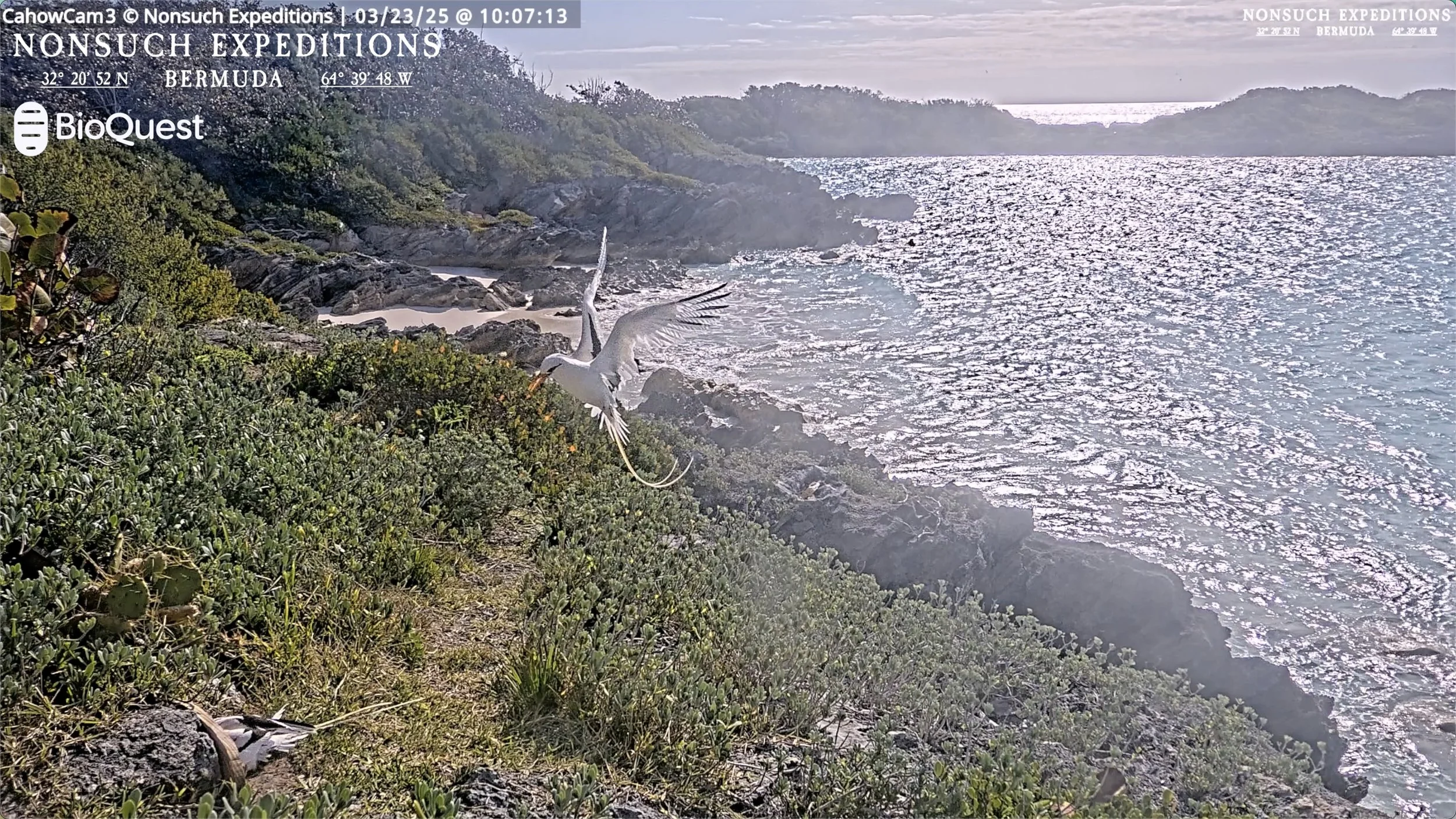
Once it started attacking the chick, the much smaller Cahow bravely lunged at it before being chased in to the tunnel, leaving the Tropicbird sitting on top of the chick.
As we had already lost a few Cahow chicks this year on the outer nesting islands to prospecting Tropicbirds that will kill the chick and takeover any nest that they can get into, Jeremy immediately dropped everything and raced to his boat to try to get to Nonsuch in time to interrupt this impending fatality…
In the early days of the Cahow recovery program, up to 2/3 of all of the Cahow chicks every season were being lost in this way until Dr. David Wingate, Jeremy’s predecessor, developed “Baffles” wooden barriers cut to block the more obvious ocean-facing burrows, which have a hole in them just large enough for Cahows to squeeze into, but too small for the usually larger full grown Tropicbirds to fit through.
These usually work, however as Jeremy has documented recently, and happened again today, persistent, smaller than average Tropicbirds can sometimes squeeze their way in and try to take over the nest, often killing whatever they find inside.
Ultimately Jeremy made it all the way from his home in Jenning’s land, to his boat in Flatts inlet, raced along a rough north shore and across Castle Harbour, and onto Nonsuch in a record 35 minutes and was able to extract the Tropicbird from the nest (which was sitting on top of, and had the chicks down in its beak) just in time to save our chick!
Zephyr, defending her sibling chick.
The adult Cahow in the nest was found as suspected to be a young female prospector (which by its presence stalled the Tropicbird long enough to save the chick), so Jeremy relocated it to an empty burrow further up the hillside, which it could claim as its own. When Jeremy was able to return home to check his banding spreadsheet and compare the band number (E0750) of the prospecting Cahow that had been with the chick, it was discovered that it had fledged as a chick from this very nest on June 12th, 2020, and named "Zephyr" by his daughter Lizzy Madeiros!
So “Zephyr” had returned just in time to save her Sibling!
To help reduce future Tropicbird invasion attempts, Jeremy then placed a mound of scurvy grass to make the entrance less visible to prospecting Tropicbirds from the air, a strategy that seems to be working on similarly exposed nest entrances on the outer islands, as unlike Cahows they are not able to walk properly / explore once on the ground and literally need to see their target from the air, and try to crashland into their nest openings.
So, the CahowCams continue to answer questions, and along with Jeremy, today at least, helped save the day…
CahowCam2 Chick's 1 st health check
During World ReWilding week, we released the first health check video for our latest CahowCam chick, one of the rarest seabirds on the Planet.
It hatched on March 9th, in Translocation Colony “A” on Nonsuch Island in Bermuda, the world-renowned, 16 Acre Nature Reserve that is now 65 years into a 100 year re-wilding process, and this video was filmed when it less than a day old…
The Cahows are a “lazarus species” thought extinct for over 300 years, which are now re-populating Nonsuch Island where they had not been seen since the 1600’s. This has been enabled by the ground-breaking Translocation Project that started 20 years ago, and is a major part of the ongoing re-wilding process, bringing the island back to a pre-colonozation state.
Our star is this year’s chick from nesting burrow #832, from which one of the CahowCams has been live-streaming for the past 15 years, and in this video he gets his first health check.
The CahowCam LiveSteams that are monitored 24/7 by the Nonsuch Expeditions, DENR and dedicated Cam volunteers, are allowing us to observe and log intimate behaviors that would otherwise be impossible. This includes nest activities around the time of this chick’s conception which raise paternity questions, which we have been studying with our partners BioQuest, and will be the subject of a future post. Similarly some of the Cahows seen in the nest over the past few nights, are acting in ways that indicated that they may not in fact be the parents, stay tuned for updates.
World ReWilding Day 2025
In Celebration of World ReWilding Day, the Nonsuch Expeditions have joined the Global Rewilding Alliance to showcase the ground-breaking Ecological Restoration effort started by Dr. David Wingate 65 years ago, which continues on under his successor Warden Jermey Madeiros and the Department of the Environment and Natural Resources, to share lessons learned, and support other rewilding efforts from around the World.
To follow is a message from Jeremy as can be seen in the attached video:
“So we're out on Nonsuch Island with JP Rouja and Haley from BioQuest, and it just so happens it's the 20th of March and today is: World ReWilding Day.
Nonsuch Island is one of the earliest examples of rewilding on the planet. Of course, back then we called it Ecological Restoration but now it's phrased as ReWilding, and it's actually about 65 years since it started, making it one of the longest lasting ones.
Among many other things, it's included the planting of over 16,000 native and endemic plants to re-establish a native indigenous forest cover on the 16 acre Nonsuch Island Nature Reserve.
Whereas before this started, it was a completely barren desert island with only dead cedars and crabgrass and not much else growing on it.
So everything you see, was planted by either: Dr. David Wingate, myself, various volunteer groups, and my work crew.
Many other projects that all went into the Nonsuch Island rewilding included:
the re-introduction of the Yellow Crown Night Heron to Bermuda from chicks that were sourced in Tampa Bay, Florida.
the re-introduction of the West Indian Top Shell, which is now once again, after a century and a half of being absent from Bermuda, was re-introduced from the Turks and Caicos Islands, and now it's found island-wide in the intertidal zone.
the protection of skinks and the preservation of the only (Nonsuch) population that seems to be really stable in Bermuda right now.
And of course the real centerpiece of the rewilding has been finally, in the last 20 years, the return of Bermuda's national bird, the endemic and critically endangered Bermuda Petrel or “Cahow”, to Nonsuch Island, because for nearly 400 years, it was confined to four half-acre rocks like Green Island, past the south tip of Nonsuch.
They are so small that in a hurricane, they go deeply underwater, they are 18 feet at their highest point, and imagine them under the impact of 25 to 30 foot waves during a hurricane, of which we've had 18 damaging ones in the last 30 years.
So I guess this is symbolic.
There are now, 40 pairs that are nesting on Nonsuch Island because of a Translocation Project moving chicks from those islands to these artificial nests on Nonsuch, and then taking over as the foster parent, feeding them daily, measuring their growth, and then letting them imprint on the island before they fly out to sea, and then waiting three to six years for them to mature and return.
The first ones returned 2009, four years after we started moving them, and the first chick was produced, name of Somers, after Sir George Somers on the 400th anniversary of the SeaVenture shipwreck, we didn't plan that, it just happened, it was serendipity.
And now, 16 years later, we have gone from one pair producing one chick, to 40 pairs producing this year, we think, about 24 chicks.
So I couldn't be happier with how the whole project is happening and how it's adding immeasurably to the Nonsuch ReWilding project.
We've been able to check all of the Cahow nests over the last couple of days in this part of the colony.
It's, I think, an indication of how fast this colony is growing, that it's taken longer and longer to do, as there's so many chicks now.
I remember when we had just one or two chicks and how excited we were, and that wasn't that long ago, it's only about a dozen years ago.
So very it's a very positive project, and when you're involved with a really successful project like this, where the species is responding so well to the management work that we're doing for it, it's it's a very encouraging and uplifting thing.
And I as a biologist, to have worked with such a fascinating species that we're still teaching us all sorts of things about the oceanic ecosystem.
So happy World ReWilding Day to everybody on a beautiful spring Bermuda full day.”
The 2025 CahowCam2 chick has hatched! Watch Replay
Our 2025 CahowCam2 Chick Has Hatched!
First Appearance: March 9th @ 20:55 | Fully Revealed: March 9th @ 20:57
On March 10th at 21:35—exactly 24 hours after the chick hatched—the male parent departed for his first foraging trip at sea. He is expected to return in a few days, while his mate is also due back soon with her own feeding contribution. Since this is her first chick, it remains to be seen if her timing aligns perfectly. Note from JP: “We’ve received many concerned messages from viewers about the chick being left alone. This is completely normal. The chick’s dense down keeps it warm without the need for constant parental coverage once it dries after hatching.”
The 24/7 live streams and archived recordings from CahowCam 1 and 2 provide a rare, intimate look at the secretive nesting behaviors of the critically endangered Bermuda Petrel (Cahow). These insights are invaluable for the conservation and management of this iconic species. To support these underfunded efforts, please consider reaching out to us.
A Countdown to Hatching
The Nonsuch Expeditions and Department of Environment and Natural Resources (DENR) teams, along with dedicated volunteers and a vigilant community of viewers, were on “Hatch Watch” after Jeremy noticed “dimples” on the CahowCam2 egg during a health check on March 5th.
Dimples are small indentations in the eggshell caused by the chick beginning to peck its way out from the inside. This marks the first visible stage of hatching, which can be confirmed by candling the egg (illuminating it with a bright light) and monitoring its weight for developmental changes.
When the dimples break through the shell and inner membrane, they become “pips,” signaling that hatching is imminent. Once the membrane is pierced, the egg begins to dehydrate. The chick must break out within about four days to avoid the risk of dying in the shell.
The monitoring team closely observed the incubating parent’s behavior and watched for brief moments when the egg was uncovered. On March 7th, during a parental handover, the male returned to relieve his younger mate. At that time, the dimples were just barely visible on camera.
The Final Stages
On the morning of March 9th at 5:30 a.m., the first small pips were spotted when the male briefly left the nest to chase away another prospecting Cahow. This moment was captured by the SurfaceCam, which is typically used to document fledging chicks, nighttime aerobatics, and territorial confrontations.
Throughout the day, the team kept a close eye on the video feed. Audible peeping sounds from the egg could be heard beneath the incubating parent. Fourteen hours later, a dime-sized hole appeared on the egg.
From that point, things progressed quickly. At 20:55, the chick’s still-wet upper body emerged from under its parent, and by 20:57, the chick was fully visible.
A New Life Begins
The devoted father carefully tended to the chick, keeping it warm and protected while its down dried. The chick emerged from under him four hours later, already begging for its first meal.
The male parent regurgitated a black, tar-like, pre-digested meal that he had stored in his gullet for several days. This nutrient-rich food will sustain the chick for its first few weeks of life. At around two months old, the chick will transition to digesting fresh fish and squid.
Watch the Chick Live!
You can follow the chick’s journey in real-time via the CahowCam live stream. Stay tuned for more updates, the full story, and video replays of this incredible event!
Hatching is underway in CahowCam2 > Hatched @ 20:57
UPDATE: Our chick has hatched and we have our first full reveal @ 20:57 after first appearing @ 20:55
On March 9th at 5:30 am, the male Cahow in the CahowCam2 burrow briefly left the nest to chase away another prospecting Cahow, revealing for the first time to the team and online viewers a fully "pipping" egg.
Click for closeup
In the video, his vocalizations are audible, followed by peeping from inside the egg as the chick responds.
The hatching process began on March 5th when "dimples" (small dents in the egg) were first observed by Jeremy. These dimples develop into "pips" once they pierce the membrane and eggshell. After this stage, the chick must fully hatch within a few days to avoid dehydration.
According to Jeremy's experience, if everything proceeds smoothly, the egg should now be on track to fully hatch within the next day or so, although it could happen within hours of this posting (written on Sunday afternoon).
Watch the LiveStream and stay tuned for updates.
Early Hatching Alert for CahowCam2!

The CahowCam2 egg has started pipping!

As of Jeremy’s latest health check on March 5th, the egg in the CahowCam2 LiveSteaming nest had started the hatching process. This starts with “dimples”, with dents seen on the egg, and progresses to “pipping” whilst the chick chips away at the egg from the inside until it breaks through, all of which can take one to four days before it fully hatches, so please keep watching the live stream, If all continues to go well, it should hatch in the next few days.
During the check, Jeremy found the new female Band# E0643 to be incubating, which was a good sign as this would be her first chick, and up to now, her mate has been doing most of the incubating…
During the same health check to Nonsuch Colonies “A” and “B”, there were 14 confirmed chicks, two more that were suspected but hidden from view in out of reach nest chambers, and 8 more eggs that were pipping, (keeping us on track to hopefully match last year’s record of 25 Nonsuch chicks), but unfortunately 3 chicks were either confirmed dead or had disappeared after hatching. *This is within a normal loss range, as historically the success ratio of eggs laid, that hatch, and the chicks survive through to fledging, ranges from 48% on a bad year, to up to 60% on a very good year, the reasons for which are behind the Genomic Population Study we are conducting with local NGO BioQuest.

24 Feb 2025 J. Madeiros with 3-4-day old Cahow chick, photos Lynn Thorne.
Elsewhere in the Colonies, during Jeremy’s last check of Horn Rock on March 1st, after checking 2/3 of the nests he was able to confirm 12 chicks and 6 eggs pipping.
A big unknown this year is the state of the Green Island Colony, which due to weather challenges and the island generally being very difficult to land on, Jeremy has been unable to do a check since November, the results from which will influence whether or not we break the record number of fledging chicks for the combined colonies (and thus the entire species), all of which are based on and around Nonsuch Island.
If you haven’t yet please sign up to our Newsletter for Alerts when the chick starts fully hatching.
Meet the earliest Cahow hatchling on record!
On Wednesday, 19th February 2025, J.P. Rouja and myself were able to make a Cahow nest check on Nonsuch Island, during which we were able to confirm the first hatched Cahow chick of 2025! This chick was found in the R833 nest at the "A" Cahow nesting colony on Nonsuch, and was already several days old, having been fed at least 2 to 3 times by the adult birds. Cahow chicks have a weight of 28 - 38 grams at hatching and this chick was already fat and healthy, weighing 68 grams, which Cahow chicks typically do not reach until they are at least 4 days old. This would make the hatch date the 15th or 16th of February, handily beating my previous earliest hatch date over the last 25 years of 18th February.
The breeding pair of Cahows in this nest is an interesting one, having nested together here since 2012 (14 years). I translocated the male parent bird on May 7th, 2008, from the Horn Rock C12 nest over to the Nonsuch Island R817 nest and it was the first Cahow chick translocated during the 5th year of the first 5-year Cahow translocation project. This chick was fed daily on fresh Anchovies (provided by Mr. Chris Flook) and squid with vitamin supplements for 17 days, and I actually observed it during a night watch fledging out to sea on the night of 24th May at 11.54pm, from the cliff edge at the "A" colony site in a steady light rain! This bird was discovered on its first return as an adult 4 years later on November 15, 2012, when it was discovered in the R833 burrow, where it has nested ever since!
The female parent Cahow from this nest, band number E0215, is a non-translocated bird which I banded as an exercising fledgling outside the Horn Rock D4 nest burrow, during a night check on 28th May 2006. It was very mature at that point and probably only 2 to 3 nights from fledging. The next time this bird was seen was as an adult in the Nonsuch R833 nest on November 15, 2011, with another returned translocated male Cahow, band no. E0250. This second bird was never seen again anywhere and probably suffered mortality at sea sometime soon after. So, the female first was seen in this nest a year before her present mate joined her, and this pair has been together ever since.
In summary, this pair have nested together for 14 years, since 2012. They are not a particularly successful pair, before this year they have only produced 3 successfully fledging chicks, in 2014, 2016 and 2018, then had unsuccessful nesting for 6 years (2019-2024). Including this new chick, they have produced only 4 chicks in 14 years (28.5% breeding success). However, despite this, at least 2 of these chicks have returned and are breeding successfully, one on Nonsuch Island, and one on Horn Rock, so they are still contributing to the recovery of the Cahow population.
In addition to this chick, 2 more eggs were recorded pipping, in early stages of hatching, in the Nonsuch R825 and R819 nests (the R819 nest produced the first hatched Cahow chick last year in 2024, so that pair definitely seem to be early birds!). At least half a dozen other eggs were very close to beginning to hatch, so the next checks should be very exciting! Jeremey Madeiros, Chief Terrestrial Conservation Officer.
JP Rouja Nonsuch Expeditions Founder: If the majority of the 30+ chicks in currently viable eggs on Nonsuch survive through to fledging, we should easily break last year’s record of 25, so stay tuned and watch the LiveSteam where the CahowCam2 chick is expected to hatch around March 7th.
CahowCam egg updates: Cam2 is fertile, however Cam1 has failed
Jeremy Madeiros: Checks of nest burrows of Bermuda's critically endangered national bird, the Cahow or Bermuda petrel (Pterodroma cahow) have been carried out all through the month of January, after the birds returned from their 5-week pre-egg-laying exodus, during which they return to the open ocean during the month of December, to feed intensively. This follows the courtship and nest-building phase of the Cahow breeding season in late October and November, when the breeding pairs return from 5 months apart out to sea during the summer months. During the December exodus period, the female develops her single large egg, while the male bird packs on extra weight and fat deposits, to enable him to carry out the majority of incubation duties.
The male birds usually return first at the very beginning of January, so that they are waiting when the females return, usually laying their egg only 1 to 2 hours after their arrival. Although it can vary between individual nesting pairs, usually the female will return to sea again within a day or two, to recover after laying the egg which can weigh 20% to 25% of her body mass. The male will then take the first long incubation "shift", which can be up to 10 - 15 days in length, after which the female returns and the pair starts to alternate shifts every 5 days or so for the remainder of the 53–55-day incubation period.
During the incubation period in January and February, I will try to visit all accessible Cahow nests to carry out checks of body weight, band numbers and sex of the incubating adult birds, as well as weighing and measuring the eggs and using a technique called "candling", where a bright light is used to determine whether the egg is fertile and has a visible embryo, and the age and stage of development of the embryo, and make sure that it is developing normally. This technique has been taught to me by Carla Marquardt, who has had years of experience working with Parrots and Macaws at captive breeding facilities in Florida and accompanies us during this period when her schedule allows.
The pair in the CahowCam 1 nest (nest no. R831) returned first, with the male bird returning at 3am on January 7th 2025, followed by his mate in the evening, which returned at 7pm, laying her egg by 8.11pm. By the 13th January, I carried out a check of this nest which confirmed that the egg was fertile, but it unfortunately had a fairly large "dimple" where the shell has been pushed in. When I checked again with Carla on 18th January, the embryo was still alive, and Carla covered the dimple with clear nail polish, which reduces moisture loss and can sometimes help the egg to finish development and hatch. However, when I checked the egg again with JP Rouja on Sunday, 26th January 2025, the dimple had become larger and the embryo had failed, so we will unfortunately not be seeing a chick in this nest for 2025. This continues this pairs history of producing chicks successfully every other year, as they fledged a robust chick, named "Vega", in 2024.
Things look much more hopeful in the CahowCam 2 nest (nest no. R832), where the male bird "Sampson" had nested with the same mate (named "Susie") since 2010, producing 12 chicks in 14 years. Susie however failed to return for 2023, and is presumed to have died out at sea, cause unknown. However, by 2024, Sampson had attracted a new younger mate, and as is usual with a first-time breeder, her first egg that year was undersized and infertile. Hope is therefore high that her second egg this year would be viable, and after the male had returned around the 10th January, we waited with some anxiety for the return of his new mate. She finally returned on the 17th January and laid a larger-than-average egg. When we checked this egg on the 26th January, it was with relief that we were able to confirm that the egg was fertile and contained a normally developing embryo. We will continue to check periodically on the development of the embryo, which if all goes well, will hopefully hatch sometime between the 9th - 14th March.
UPDATE: Februay 16th J-P Rouja: The CahowCam2 egg as of last check was still fertile with the parents dutifully incubating as can be watched LIVE here, however, the failed egg in CahowCam1 remained intact until February 3rd when one of our volunteers noticed that it seemed to be stuck to the belly of the incubating parent. The weather was not allowing Jeremy and I to get out to Nonsuch at the time, however fortunately, the side/profle view given by Cam1 allowed us to determine that the egg was mostly intact but must have ruptured and leaked through the dimple and then dried and stuck to the parent’s belly feathers. It proceeded to keep incubating and drag it around the nest, including when its mate returned, and then eventually flew out to sea where we assume it bathed and washed it off before returning without it a few days later, all of which was documented by the Cam and can be seen in the attached video.
Failed egg still attached to parent on Feb 3rd
As Jeremy has observed in the past and has now been confirmed by the CahowCam live feeds over the past decade, when an egg fails the parents do not immediately abandon it and the nest. In some cases, the egg will remain intact for several weeks until it eventually explodes and the parents will dutifully keep “incubating” it throughout. One might think that they simply did not know it had failed, however as has been observed in the case of CahowCam1 this season, even after obvious failure and its’ removal from the nest, they will stay on and keep “incubating” the failed egg/empty nest.
As of this writing on February 16th they are both back in the nest today and are continuing to go through the motions of incubating, though there have now been periods where our viewers have observed an empty nest, which will become the norm once they fully abandon it for the season. They will then head out to sea and return to try again in late October, and as Jeremy has observed, pairs with failed eggs, which do not need to keep incubating and then feeding their chick until late May / early June, will have had more time out at sea to fatten up, and generally return heavier and in better health for the next season.
So for this season lets keep watching CahowCam1, whilst the remainder of the Colony is on track for another great year.
Watch the CahowCam2 Egg-Laying Sequence

On January 17th the CahowCam2 female returned and promptly laid her egg!
At that point, “Sampson” her mate, one of the largest birds in the Colony, had been waiting for over a week. This is not the norm for the Species for which we have found that their nesting return times are generally well synchronized, despite having months apart at sea.
In this case, this may be due to this being their second season together, as she replaced his original mate, which did not return last year. Up to that point, Sampson and his prior mate were one of the most productive pairs in the Colony, having successfully fledged a chick 13 of the past 14 years.
As was to be expected, this new young female’s first egg failed last season, but time will tell if they will be as successful going forward.
Stay tuned to our LiveStreams to learn more.
The CahowCam1 male has returned and now awaits his mate - UPDATE: She has laid her egg!

UPDATE: As predicted she arrived at 6:59pm and @ 8:11 pm she revealed her egg…
The CahowCam1 male has returned (watch LiveStream here) and his mate is expected as soon as tonight amongst an influx of Cahows returning in the high winds, for the start of the 2025 nesting season egg-laying period.
On January 6th Jeremy was able to get out to Nonsuch during a brief lull in the weather where he found that 11 out of 38 nests in “A” colony had returned birds, 6 with confirmed eggs, and 5 with males awaiting their respective females.
The Cahows will only approach land under cover of darkness, and then ideally on the edge of a storm or squall where they ride the wind to save energy during their long-distance travels.
This has been proven time and again by watching the Nonsuch Expeditions Surface CahowCam in colony “A”, and last night was no exception when right on schedule, during an extreme squall at 3am the CahowCam1 male can be seen crash landing into the bay grape thicket on the edge of the colony. It then disappeared off camera before appearing a minute later in the entrance of the CahowCam1 burrow where he then settled in to wait for his mate.
Earlier that evening a large land crab was filmed stealing a large bay grape leaf from the nest which it has been scavenging from over the past month whilst the Cahows were out at sea. Now that they are back we will probably see less of it until the end of the nesting season as it tries to avoid confrontations.
Tune into the CahowCam1 LiveStream starting tonight as the female is expected to return over the next few nights and usually will lay her single egg within an hour of arrival, which for one of the rarest seabirds on the planet is a major event to witness.
Cahows are returning for the 2025 egg-laying season
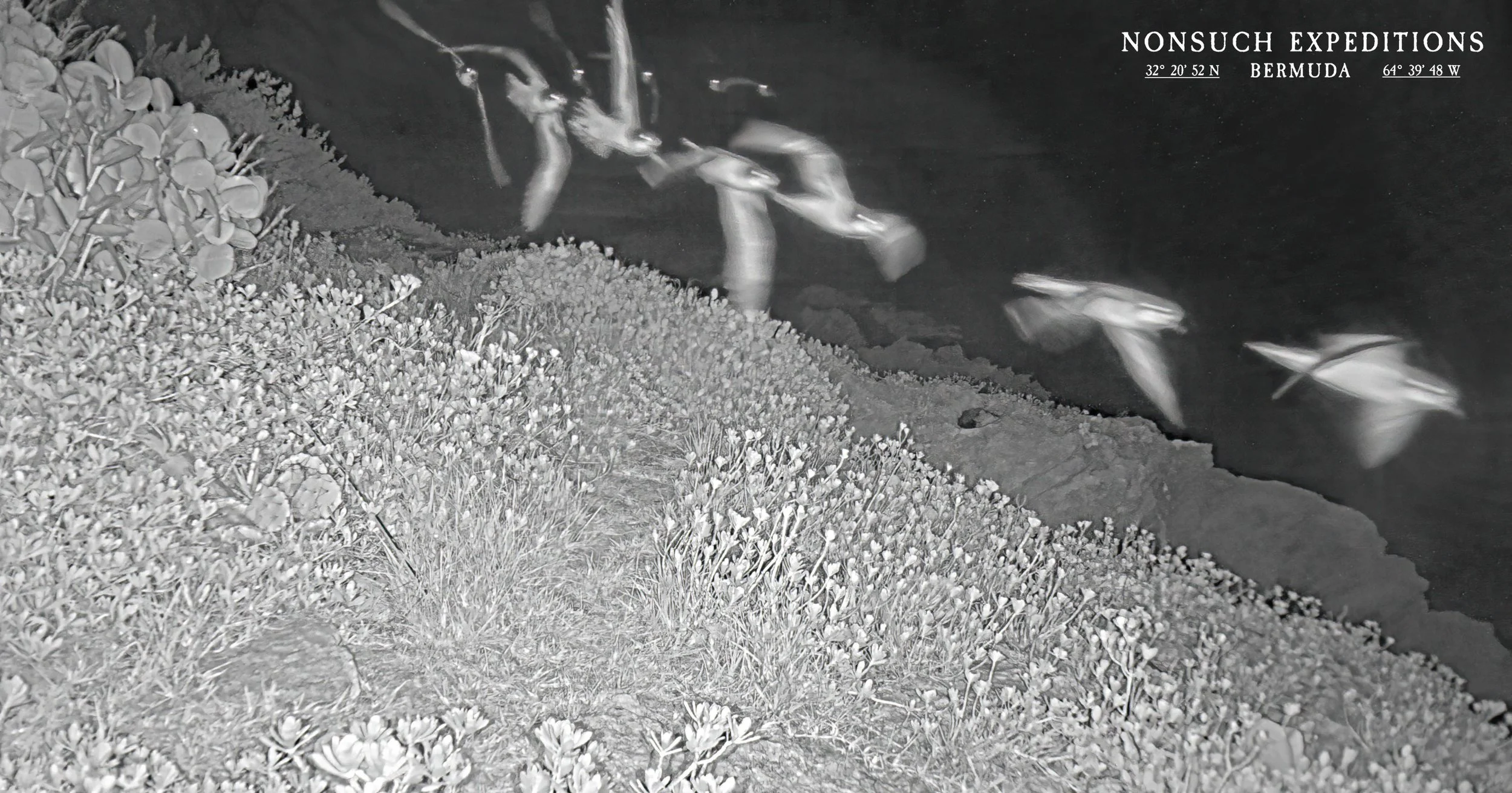
Combined video frames of Cahow flying past CahowCam3 - January 2025
The return of the Cahow (Bermuda petrel) breeding population to lay their single eggs in their underground nest burrows (watch LiveStream here) on the Castle Harbour Islands has begun in earnest, despite the gale-force winds currently sweeping across Bermuda.
I was able to go out to Nonsuch Island on the last day (Dec. 31st) of 2024, confirming the 1st returned female bird (band no. E0215) in the R833 nest. After returning from the open ocean and carrying out courtship, mating and nest-building in late October & November, Cahows return to sea for 5 weeks during late Nov. and December to feed intensively, the female to develop her single large egg, the male to pack on fat reserves to start the first long incubation of the egg, lasting up to 15 days, while the female returns to sea to recover from laying an egg that masses 20% or more of her body weight. This female was at a healthy post-laying weight of 340 grams, while her egg weighed 56 grams.
Yesterday on 3rd January 2025, I travelled out to Nonsuch in rough conditions with student Noah DeSilva (who was collecting soil samples on Nonsuch for a study) to carry out another check ahead of today's forecast gale. Cahows had returned to a total of 5 nests, upon checking the R833 nest, the male bird (band no. E0276, translocated as a chick to Nonsuch in 2008 and weighing in at an impressive 446 grams) had returned and was incubating the egg, while the female had left him to it and returned to sea.
In addition, one male Cahow (band no. E0853) was sitting in the R829 nest waiting for the return of the female (no egg yet), a newly returned female (band no. E0623) was in the R825 nest incubating a newly laid 59-gram egg and waiting for the return of her mate, while female no. E0768 was incubating a 55-gram egg in the R819 nest. In the R818 nest burrow, a newly returned adult Cahow was incubating an egg, so probably the female bird (not disturbed).
I thought that with a gale commencing later that night, that we would see a surge of returning Cahows flying in and returning to lay their eggs, as Cahows seem to love strong winds. Sure enough, the infrared "surface cam" at the "A" Cahow colony, viewable on the nonsuch expeditions website, captured a good number of Cahows zooming in over the colony, especially between 8pm and 9pm. I was even able to see a couple of them land, possibly at the R834 and R835 nests, and hurry inside their burrows.
Gale and Storm-force winds have been blowing all morning, reaching 52 knots (60mph) at the airport and 64 knots (75mph) at the Bermuda National Museum, accompanied by squally showers. Strong winds are due to continue for at least a few days more, so I expect by the time I get back out to the islands, many more of this critically endangered seabird will be back and contentedly incubating their single eggs!
If you are interested, watch the surface cam over the next several nights on visit the CahowCam page and scroll down until the surface cam comes up. In addition, Cahows in the CahowCam 1 webcam nest are due to return any night now, in previous years they have returned anywhere between 7th to 10th January.
Happy Holidays from Nonsuch Island in Bermuda

J-P, Jeremy, and the extended Cahow family wish our followers Happy Holidays and a Healthy and Happy New Year!
Stay tuned for another record-breaking year from one of the most successful and longest-running rewilding programs, home to several critically endangered species: www.nonsuchisland.com
Summary of Courtship/Nest-Building Phase of 2024-2025 Cahow Nesting Season
This extended Season Introduction video was supported by the MbZ Species Conservation Fund
The breeding population of Bermuda's endemic national bird, the critically endangered Bermuda petrel, or Cahow (Pterodroma cahow), returned to the sole nesting sites on the Castle Harbour Islands Nature Reserve during late October 2024, staying through the month of November for the courtship & nest-building phase of its lengthy nesting season. The first Cahows were confirmed back in their nest burrows on the very early date of 14th October and have been surveyed through late October and November during regular visits to Nonsuch Island and the other 5 smaller nesting islets and rocks. The combined area of all 6 nesting Islands, including Nonsuch, totals only 22.2 acres, of which Nonsuch by far is the largest of these at 16.5 acres.
However, the weather conditions during much of November have been characterized by lengthy windy periods, making it too dangerous to travel out to and land on the nesting islands except on just 1 or 2 days of each week, rather than the more usual 3 to 4 days. I normally try to check nests on each of the nesting islands during this period to briefly remove any adult birds present, which are checked for weight, wing chord (outer wing length), and most importantly, the number of the band or ring fitted to the leg of Cahows when they are chicks in the nest. The birds are then returned to their nest burrows after these brief checks. The general body condition and health of the returning Cahows can be determined from their weight and wing chord length, and their band/ring number can be referenced to identify the bird's age, nest of origin, parent birds in many cases, and which birds are nesting with which mates in which nests. This basic information has confirmed that Cahows are overwhelmingly monogamous, with the same birds nesting with the same mates in the same nest burrows for in many cases over periods of 24 years or more.
During this courtship/nest-building period, I normally try to process or handle & measure at least 100 adult Cahows, but due to the windy conditions this year, I have only been able to handle about 80 birds. As of this writing (in late November) I still have about another week to try and get out to carry out checks and hopefully process some more Cahows, but the population will then return back out to the open ocean to feed intensively during the whole month of December, the females to develop their single large eggs, and the males to build up fat reserves to carry out most of the early egg incubation. After the birds return in the new year to lay their eggs in their underground burrows and begin egg incubation, I have an objective of processing at least another 100 Cahows during the egg incubation period of the nesting season in January and February.
So far this season, I have been able to confirm that almost all adults are in good body condition and at good weights; I have also been able to confirm at least 4 first-return birds, that is, young birds that have been out at sea for 3 to 5 years after fledging as chicks, and are now mature and returning for the first time, the males to choose new nest burrows and attract potential mates, and the females to choose mates with good nests. As we move into the December, pre-egg-laying exodus period, I will try to finish several new artificial nest burrows, in time for the return of the breeding adults for egg-laying, an event that I always look forward to!
Jeremy Madeiros | Principle Scientist - Terrestrial Conservation | Dept. of Environment and Natural Resources
The Cahows are back for the start of the 2025 Nesting Season!

Pair in CahowCam1 Burrow
On the evening of October 23rd 2024, one of Cahows returned followed by its mate a few hours later, officially starting the 2025 CahowCam Nesting Season LIVEstream!
In the interim, as captured by the CahowCam, there was an altercation with another prospecting Cahow that entered the nest but was ejected after a short fight… (please check back for video replay) otherwise watch the LIVEstream here now.
Historically the Cahows did not return for the month-long courtship, mating and nest-building period until November, however, with global warming, they are returning earlier and earlier with record numbers already back at the colony thus far. Stay tuned for another record-breaking season.
This season’s internet access is being provided by Digicel, who we thank for their support!
Hurricane Ernesto - Live Video and Updates from Nonsuch Island Bermuda

*This page will be maintained and updated as long as possible throughout the storm, please Bookmark and visit back Stay safe everyone!.
POST HURRICANE UPDATE: Despite direct passage of the eye, fortunately Ernesto decreased to Cat1 just before passage and Nonsuch had relatively little damage. Our SurfaceCam which has endured multiple stronger hurricanes over the years did not survive and is in the process of being upgraded and replaced.
UPDATE Aug 18th 2024 J-P Rouja: The LiveStream stayed live until 7:30 am on the 17th with an archived loop seen below. The Hurricane has now passed and the team is waiting on getting our vessels back in the water so that we can go and do a damage assessment, however we are not anticipating good news due to the almost 24hr onslaught of storm and hurricane force ocean swells on the coastline… Please stay tuned for more info.
The southern, ocean-facing side of Nonsuch, which is located on the South East corner of Bermuda, is bearing the full brunt of this Hurricane with 120+ mph winds and 30ft waves expected by Saturday morning, which when combined with storm surge and high tide at 7am is going to be disastrous to Nonsuch, but especially the surrounding nesting islands…
In past Hurricanes Nonsuch’s completely off-grid solar power coupled with the Nonsuch Expedtion’s remote cameras and wireless internet have remained live throughout the storms broadcasting a LiveStream from the SurfaceCam in Cahow Translocation Colony A. Please find the current LiveStream embeded below along with updates that our team will post as long as conditions allow throughout the Hurricane. Big thanks to Digicel for the internet access once our signal reaches them on the Bermuda mainland.
Replay of Live view from Nonsuch Translocation Colony A (scroll back in timeline to review)
6am Update from J-P Rouja: We are now passing through the eye of Ernesto and with sunrise approaching we should finally see the waves that have been pounding Nonsuch and the outer nesting islands throughout the night. Whilst the closest approach of the Hurricane has passed, we will still be dealing with storm-surge on top of the high tide at 7am. Stay tuned for more updates…
10pm Update from J-P Rouja: Though I had lost my power by 4pm, our Nonsuch LiveStream is still going and throughout the day was picked up internationally by CNN, Weather Channel, Reuters and countless others… As of right now we are only seeing the what the infrared lights can reach, which does not include the water, however if we are still live at sunrise we will witness the full force of Hurricane waves on top of storm-surge, and a high tide at 7am, which will undoubtedly look impressive but is going to be disastrous to Nonsuch and the surrounding nesting islands…
Friday Update from: Jeremy Madeiros: My assistant Peter Drew and the Conservation Crew spent Tuesday clearing 2 boatloads of plastic flotsam from Nonsuch that we had been collecting for over a year for local schools to analyze, and took it ashore to store so that it would not be spread all over the Castle Harbour Islands.
I joined Peter on Nonsuch on Wednesday so we could secure all doors and windows on the buildings there, and took some equipment ashore, dodging thunderstorms and showers. I also surveyed a couple of the islands for low-lying Tropicbird (Longtail) nests to see if any chicks were left, luckily all chicks at risk have already fledged from Southampton Island (not the Parish), but I did have to move a nearly fully-fledged chick from Nonsuch Island and take it ashore in a box, as its nest is probably underwater by now.
It is now one of 6 Tropicbird chicks that are being cared for by Wildlife rehabilitator Lynn Thorne, she has a generator to keep the Anchovies and squid needed to feed them frozen, while my forest-surrounded house will certainly loose power (we have already had gusts to 55 knots/63 mph, and my lights are already flickering). I anticipate the smaller nesting islands will take a battering as hurricane Ernesto is slowing down as it approaches, with hurricane-force winds commencing in the late evening and possibly lasting until midday tomorrow.
Good luck everyone!
Record Breaking 2024 Nesting Season for Bermuda Petrel on Nonsuch Island
In collaboration with Nonsuch Expeditions, the Department of Environment and Natural Resources (DENR) is delighted to announce the successful conclusion of the 2024 nesting season for the Bermuda Petrel, also known as the Cahow.
“Although we fell just short of the 2021 record of 78 fledged chicks, with 76 this year throughout the entire colony, we have set a new record on Nonsuch Island," said Jeremy Madeiros, DENR terrestrial conservation officer. "The translocation colonies have shown over a 25% increase, with 25 fledged chicks compared to last year's 19, making Nonsuch Island the most productive sub-colony for the species."
This success is particularly notable given that the first chick for the new Nonsuch Island population was produced in 2009, thanks to the Translocation Project. Previously, no Cahows had nested on Nonsuch Island or any of the other larger Bermuda islands since the 1620s due to the introduction of mammal predators such as rats, cats, dogs, and pigs and overhunting by early settlers.
This remarkable achievement highlights the dedicated conservation work over the past decades and fully confirms the success of the Translocation Project work that was carried out between 2004 and 2017 by Jeremy Madeiros. The original Cahow Recovery Project, one of the longest-running recovery programs for a critically endangered species, was initiated by Dr. David Wingate from 1962 to 2000 and is currently led by Mr. Madeiros from 2000 to 2024. It is also a signature part, and a keystone species in the overarching rewilding of Nonsuch Island during the same period.
At a recent talk at the Bermuda Underwater Exploration Institute (BUEI), Mr. Madeiros and Nonsuch Expeditions Founder J-P Rouja presented the latest statistics on the Cahow Recovery work. They also shared findings from collaborations with researchers from Canada, the U.S., and Italy. While most threats to the Cahow at its breeding grounds in Castle Harbour have been controlled, issues such as erosion, flooding from sea-level rise, and stronger hurricanes pose new challenges. However, Nonsuch Island remains less affected due to its larger size and higher elevation.
Persistent Organic Pesticides (POPs) detected in adult Cahows continue to be a concern, as they negatively affect breeding success. These compounds, including DDT, DDE, and Hexachlorobenzene, remain in the marine food web despite being banned over 20 years ago.
GPS tracking tags have also provided valuable data on the Cahow's range and feeding areas, revealing that they travel over 3,000 miles from Bermuda to waters near Ireland, northwest Spain, and as far north as Newfoundland and Iceland.
Deputy Premier and Minister The Hon. Walter Roban said: "The record-breaking numbers this year are incredibly encouraging. It's clear that our ongoing collaborations with Nonsuch Expeditions and local and international partners are making a real difference in the recovery of this iconic species."
Jean-Pierre Rouja, founder of Nonsuch Expeditions and CahowCam developer, added: "Our CahowCams and LiveStreams, launched over 13 years ago, continue to aid in the protection, recovery, and management of the species. With technical assistance from the Nature Conservancy, we've also installed a solar-powered, wirelessly meshed network of camera traps, with a custom AI trained to detect early signs of rodents and other threats."
Nonsuch Expeditions' ongoing work with the DENR has been recognized as one of the top conservation efforts globally with a special Chairman's award from the Mohamed bin Zayed Conservation Fund (MBZCF).
"The MBZCF award is a game-changer for our projects," said Rouja. "It brings international recognition and much-needed support, helping to enhance our monitoring and predator control capabilities and build new concrete burrows for the Bermuda Petrel."
In partnership with local NGO BioQuest, and following the completion of the Bermuda Petrel reference genome last year, to further aid recovery management of the species, the MBZCF grant will also support the first phase of a genomic population study.
Nonsuch Expeditions and DENR look forward to progressing the conservation of Bermuda's national bird and thank all partners, sponsors, and volunteers, especially those from Cornell Lab of Ornithology and the crowdsourced volunteers monitoring the CahowCam live streams, for their support.
Nonsuch Expeditions Wins Mohamed bin Zayed Species Conservation Fund “Chairman’s Award”

At the wrap up of another record-breaking nesting season for the critically endangered, Bermuda Petrel, the Mohamed bin Zayed Species Conservation Fund (MBZF) has awarded a special “Chairman’s Award” in support of the Nonsuch Expeditions ongoing conservation efforts with the Bermuda Governments Department of the Environment and Natural Resources (DENR), on Nonsuch Island, Bermuda.
The Fund supports boots-on-the-ground, get-your-hands-dirty conservation of threatened species worldwide, with particular focus on lesser-known species that may not receive widespread conservation attention. It provides hundreds of smaller grants per year directly to those doing important fieldwork, of which a handful are selected each year for the prestigious “Chairman’s Award” as being representative of significant conservation efforts worldwide.
“This particular project, supported by Dolphin Energy, was selected for the Chairman’s Award by the members of MBZ Fund Advisory Board on the basis of its ambitiously realistic conservation objectives applied to a critically threatened species, the Bermuda Petrel, and its associated nesting habitat.” Nicolas Heard, Acting Director General, Mohamed bin Zayed Species Conservation Fund
For the past 17 years the Nonsuch Expeditions have supported, participated in, and showcased the DENR’s conservation efforts on and around Nonsuch Island including work with the critically endangered, endemic Bermuda Petrel. Also known as the Cahow it was thought to be extinct for over 330 years until 17 pairs were discovered nesting on remote rocks in Castle Harbour in the 1950s. Thanks to a pioneering recovery program initiated by Dr. David Wingate, followed by a groundbreaking translocation project launched by his successor Jeremy Madeiros, they are as of this year back up to 165 pairs.
JP Rouja, founder, and Cahow champion for the Nonsuch Expeditions, directly assists the Warden Jeremy Madeiros, and provides conservation technology and media support for the programs. Additionally, the team looks for conservation challenges that the island and its various species and programs are facing that can be solved by technology, collaborates with global partners to source and deploy solutions, and develops novel custom technologies when necessary.
“We are thankful for the International recognition this very special MBZF "Chairman's Award" brings to us for 17+ years supporting, participating in, and showcasing Jeremy Madeiros and the DENR's tremendous work, whilst building on David Wingate's ground breaking legacey” Jean-Pierre Rouja, Nonsuch Expeditions Founder.
One of the signature projects is the decade+ long CahowCam project, which enables anyone from around the world to tune in to watch the nesting activities of Cahows unfold via the custom built ‘CahowCam’ – livestreaming video cameras set up in the underground burrows. Not only do the CahowCams open the world of the Cahow to Bermudians, children, and civil society – it also allows for increased scientific understanding of the birds from 24/7 observations of their nesting habits, and the crowd sourcing of observation and data collection.
The MBZF Fund Chairman’s Award is accompanied by a $25,000 grant, supported by Dolphin Energy, which will assist the signature CahowCam project, and will be divvied up to boost the Nonsuch Expeditions other ongoing projects, but most importantly, it is hoped that the international recognition will attract further international support, as these efforts are currently underfunded. (Contributions can be made here).
Some of this ongoing work includes:
·Following on from producing the reference genome of the Cahow with local partner BioQuest (a Bermuda based NGO partner, leveraging genomics for conservation) in 2023, the grant will allow the team to initiate the first phase of a follow-on genomic population study of the Cahow, which will greatly enhance the management of the species.
The ongoing maintenance, and expansion to other nesting islands of an AI powered, rodent detecting camera trap platform on Nonsuch Island that was installed in 2023 with technical support from the Nature Conservancy. The custom AI is being trained to identifying rodents which are a massive threat to nesting Cahows and Nonsuch biodiversity overall. These traps capture thousands of images on the island which are uploaded to the cloud where a custom AI will determine if rats have been detected, allowing for quick response to protect the nesting sites of the vulnerable birds.
The funding will also support the installation of a new batch of artificial Cahow burrows. These are each made up of 600-800 lbs of concrete, which is traditionally mixed by hand then carried in buckets to the remote islands, which the grant will help accelerate through the use of a barge to produce a first batch.
It will also help support the ongoing production of short-form videos shot weekly throughout the nesting season that are used for education and global public outreach.
*This grant is follow on to a similar grant made to our overseas collaborators in 2019 at the start of the ongoing Bermuda Petrel Biomonitoring Project, and in this instance is being made directly to the local Nonsuch Expeditions Team.
To watch the LiveStreams visit this link.