

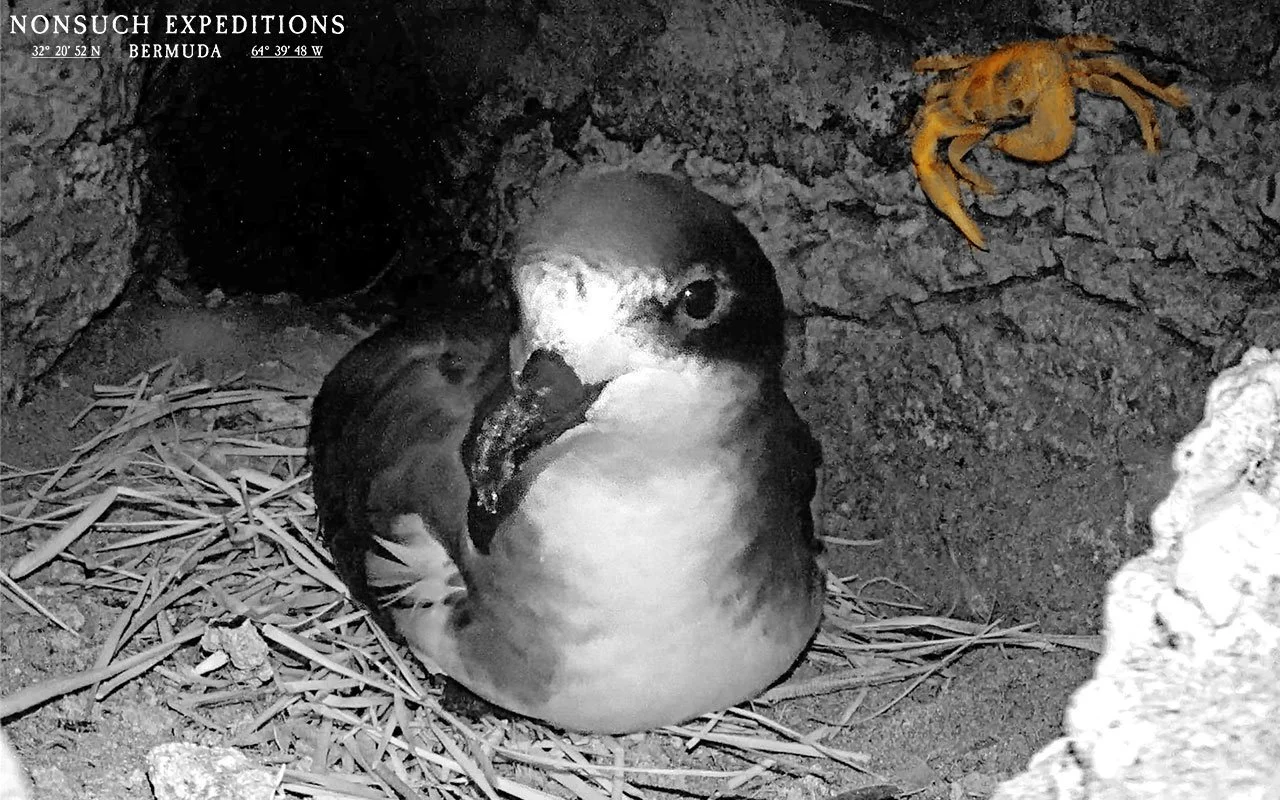
The 2026/2027 Cahow Nesting Season has officially started with Jeremy’s first “bird-in-hand” during a visit on October 16th and the first bird seen on the CahowCam1 camera on October the 19th. In this instance it may have been one of the resident pair, though possibly also a prospector as it did not stay long. The resident landcrab which has had burrow to itself for the past few months is seen (highlighted in orange) in the background.
Repost from Jeremy Madeiros: “The first Cahows or Bermuda petrels (Pterodroma cahow) are returning back to their nest burrows on Nonsuch Island and several other small, exposed nesting islets in Castle Harbor, Bermuda.
Cahows spend the summer months (late June to mid-October) at sea in from the Mid-Atlantic Ocean mainly north of the Azores, but also extending from well offshore of the Carolinas and Canadian Maritimes all the way northeast to waters southwest of Ireland and off northwest Spain. Cahows return to Bermuda in late October, carry out courtship and nest-building in November, return to sea in December, and return to lay eggs in early January, with the last chicks not fledging until early June.
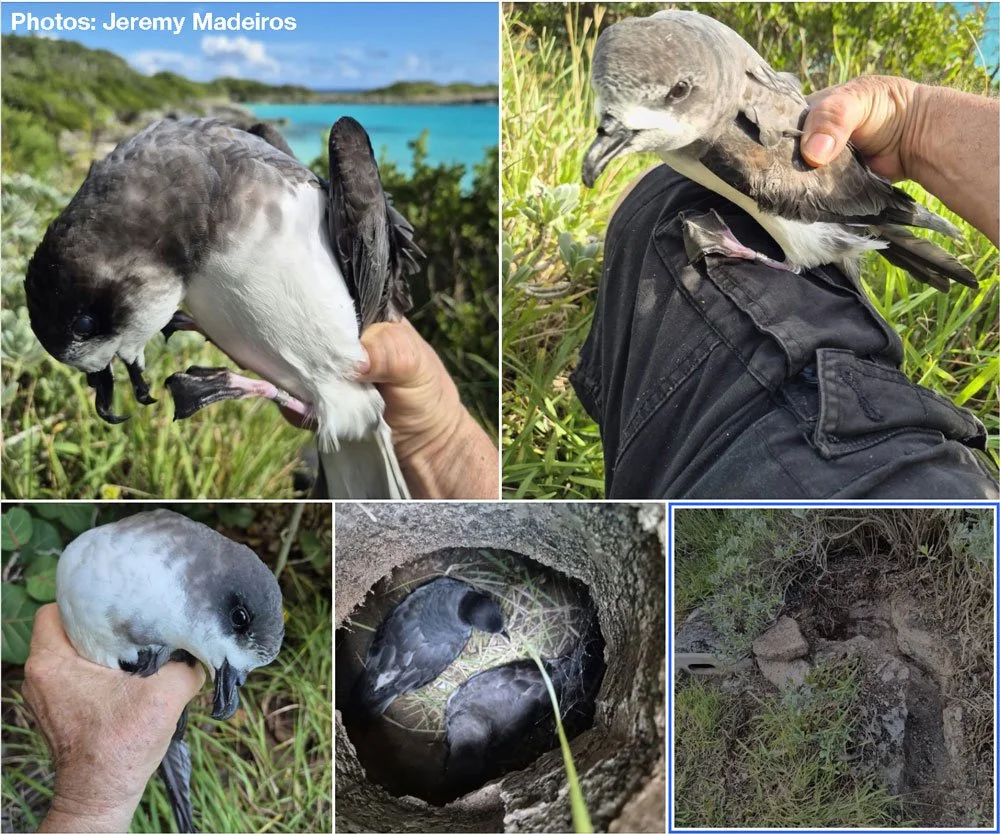
On 12th October, Paul Watson sighted two Cahows outside the reef line from Coopers Island Point, followed on 16th October by the first two birds that I located in nests on Nonsuch Island. This week on the 21st October, I counted 10 returned Cahows in nest burrows on Nonsuch, out of a total of 80 birds (40 pairs) that breed there, and was able to take some photos. These included the large male Cahow from the R833 nest (band no. E0276), which weighed in at an impressive 417 grams (the first 2 photos). In addition, a newly returned prospecting Cahow (band no. E0579) was busy digging soil out of a new nest he was trying to colonize (3rd photo, going counter-clockwise from top right).
On my last check yesterday (Friday 23 October) I counted a total of 20 adult Cahows back on Nonsuch, including 6 pairs together (4th photo), all of which were busy building grass & leaf nests. This included my "Genesis" pair in the R836 nest, which after producing 15 successfully fledging chicks in 15 years, finally had their first failure last breeding season. Hopefully, they will be successful again this season.
In addition to monitoring the return of the breeding Cahows, I have also been excavating seven new nest burrows with the help of Conservation Officer Peter Drew, and volunteer Miguel Mejias. Three of these will be the tried-and-true concrete burrows which can last 60-70 years or more, and 4 will be hybrid burrows with plastic nest chambers from Australia and concrete entrance tunnels.
Most are now ready for concrete to be poured to build the nest chambers, and a few days later, the first half of the entrance tunnels.
I am happy that we were able to get this work to this point, as winds are increasing, rain is approaching and the forecast is for the next five days to have strong winds up to gale-force, and widespread rain and showers, which will no doubt keep us ashore.”