

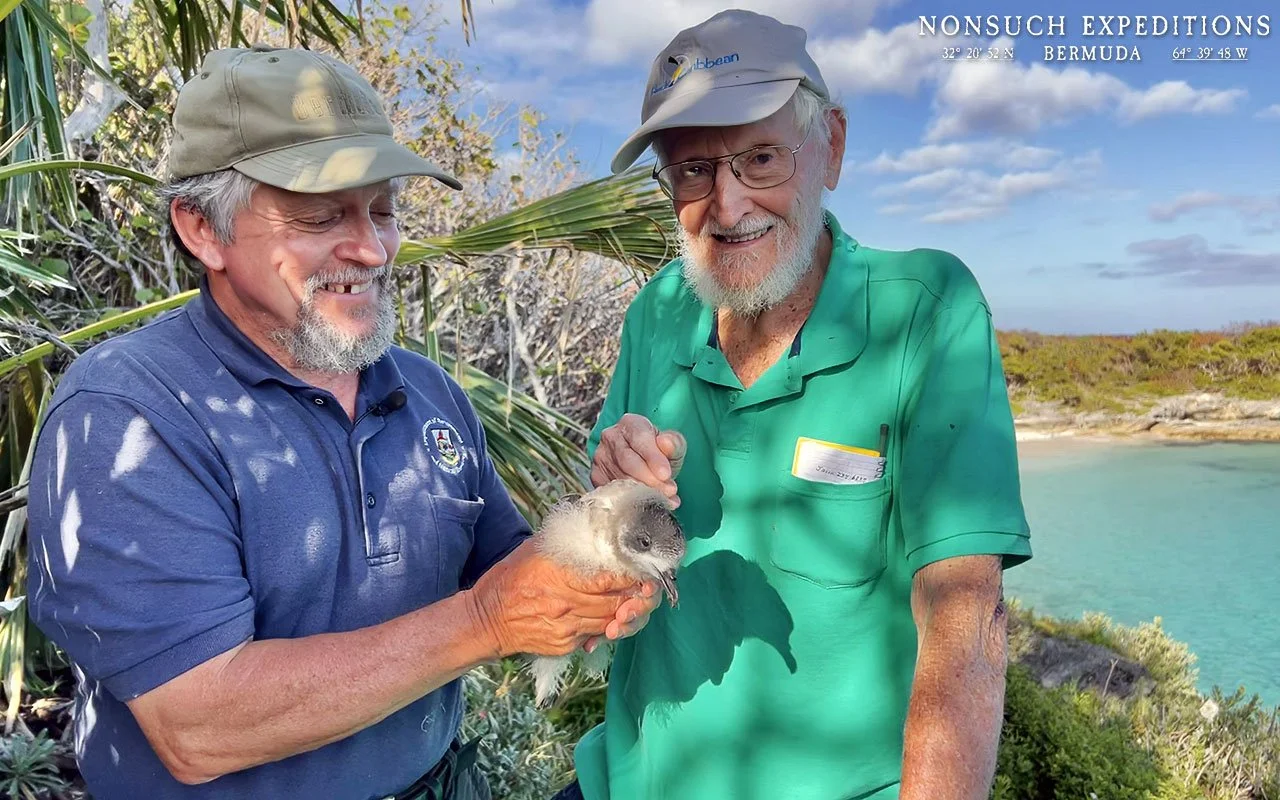
A tribute to David Wingate, the Grandfather of the Environment and modern Conservation on Bermuda, and the Savior of the Cahow, or Bermuda petrel. By Jeremy Madeiros
“On Tuesday, Nov. 10, I received a call from Rosalind Wingate, David Wingate’s youngest daughter, to tell me that her father had peacefully passed away earlier that morning.
Bermuda had just lost a giant of Conservation and the Environment, and the single person most responsible for the protection of most of the island’s surviving wetlands, ponds and protected areas. These areas add so much to the Natural beauty of Bermuda, improve our quality of life, and are important to and are enjoyed by both residents and visitors to the island.
Of course, what David will always be best remembered for is his groundbreaking work with what became Bermuda’s official National Bird, the unique and critically endangered Cahow, or Bermuda petrel, and his related and parallel work with the ecological restoration of Nonsuch Island to a “Living Museum” of what Bermuda looked like before the arrival of humans on the island.
I first met David 42 years ago, in 1984, when I joined the Dept. of Agriculture and Fisheries Apprenticeship Program, on the advice of David’s second wife Elizabeth, who was a regular shopper in my family’s business, the Friendly Store in Warwick. She suggested that with my interest and knowledge in Bermuda’s Environment, I should consider the Program, then run by Government Horticulturalist Barry Phillips. A couple of weeks later, I went into the Botanical Gardens office for an interview with Barry, who introduced me to David Wingate, whose work I had been following avidly as a young Bermudian interested in animals and the environment. The Apprentice Program mixed educational classwork and lectures with practical work placements lasting up to 6 months, and David requested me for my first 6-month placement working with his Conservation Section.
I was overjoyed, and I well remember my first day working with David and his crew in Paget Marsh, felling invasive Chinese Fan Palms. Using an old Homelite chainsaw, with a non-functioning chain brake, David cut his ankle to the bone, barely missing his Achilles tendon. He asked me to come with him to the hospital in his truck, but insisted on driving as the blood ran, instructing me to “grab the wheel in case he passed out”! After we parked and as he limped over to the emergency dept. at the hospital, leaving a trail of blood, I confess that I asked myself, “my god, what have I gotten myself into?”
A few weeks after this memorable introduction to working with David, I travelled with him out to Nonsuch and the Castle Harbour Islands, where he showed me the first Cahows I had ever laid eyes on, secure in their underground nest burrows having recently returned from spending the summer out on the open ocean. At that time, there were only about 30 breeding pairs of Cahows on the planet, with their situation still being extremely precarious. I had up until then been mainly interested in native & endemic plants and botany, but like David always had a deep-seated instinct for stewardship, and saving plants and animals that were sick, endangered or in trouble. The incredible survival story of the Cahow spoke to me, and over the next years of working with David, I was hopelessly “corrupted” into a seabird biologist as my main passion, a process helped along during my time in the United Kingdom in college, where one of my favorite studies was determining hunting territories and prey items for the Barn Owl with local experts in Surrey, and managing habitats for birds and other wildlife.
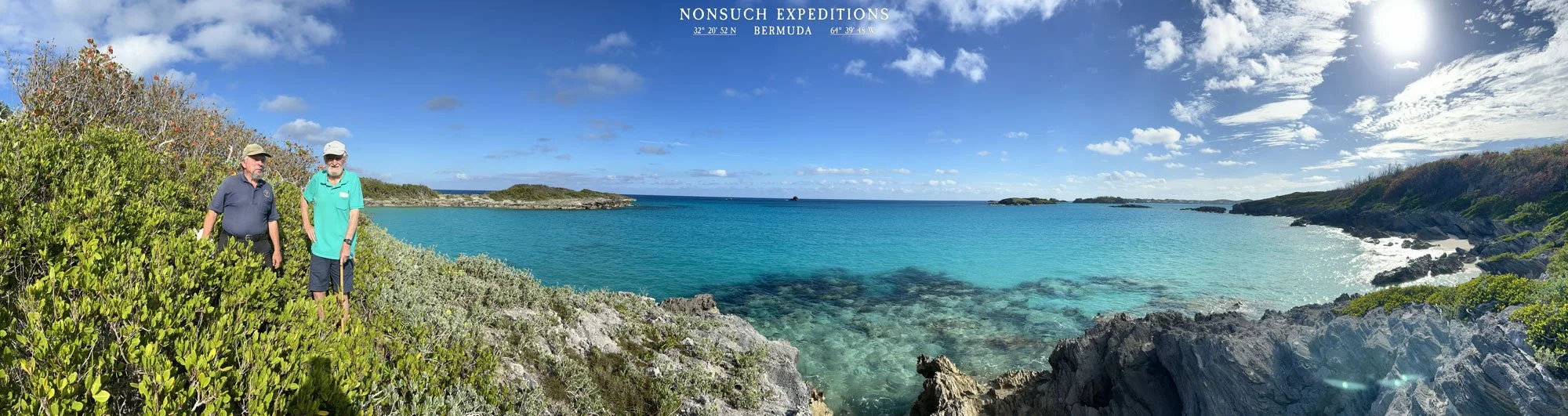
David & Jeremy, Nonsuch Island Cahow Cove 2023
David visited me in England and we kept in touch, and when I returned to Bermuda in 1991, the position in the Conservation Section that I originally went to college for had been cut, so I became a Parks Superintendent for the next 9 years, which I enjoyed, but still volunteered on weekends to work with David specifically on the Cahow Recovery Program. By the time David retired in 2000, after 40 years as Bermuda’s Conservation Officer, the numbers of Cahows had increased to 53 breeding pairs, and I applied for and was accepted to fill his position.
When I assumed the post, Bermuda had been impacted by a number of hurricanes, which caused severe damage to the tiny nesting islands that the Cahow was at that time still confined to. I realized that hurricane erosion and damage, coupled with sea-level rise, had become the greatest threat to the Cahow, After a fortuitous visit by Australian seabird biologist Nicholas Carlile of the New South Wales dept. of Environment and Climate Change in 1999, he invited me to Australia for a month’s training in handling, measuring and ringing (banding) a variety of seabirds, He most importantly showed me his translocation project for the endangered Gould’s petrel, in the same Gadfly petrel family of seabirds as the Cahow. I became convinced that the same technique, very new at the time, could be used to address the problem the Cahow faced, and could be used as a short-cut to re-establish the Cahow on Nonsuch Island, much higher, larger and safer as a breeding site for the Cahow.
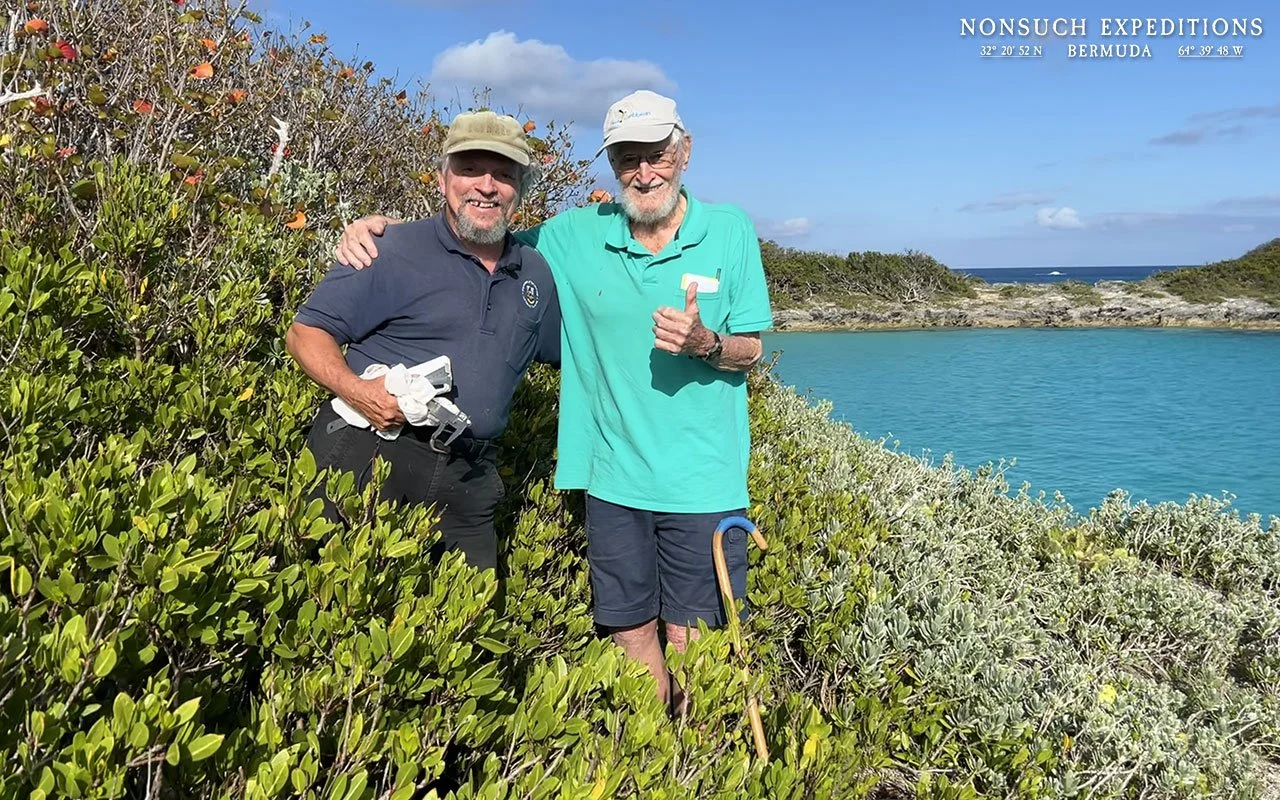
This project as we know was successful beyond our wildest dreams, but the new techniques and priorities being used alarmed David as being too risky leading to a good deal of criticism. It is well-known that this caused real disagreement between David and myself, badly affecting our relationship for quite a number of years, although we still continued to work together occasionally because of our mutual love for the Cahows and the environment. I would like to stress that I never lost my deep respect for David for all that he had accomplished and his unwavering commitment to Bermuda’s environment and in teaching the next generations of young conservationists, just as he had been my longtime mentor. I am very happy that in the last years before his death that we had largely reconciled and repaired our relationship, and I was able to regularly update him on the progress of the Cahow work and talk with him.
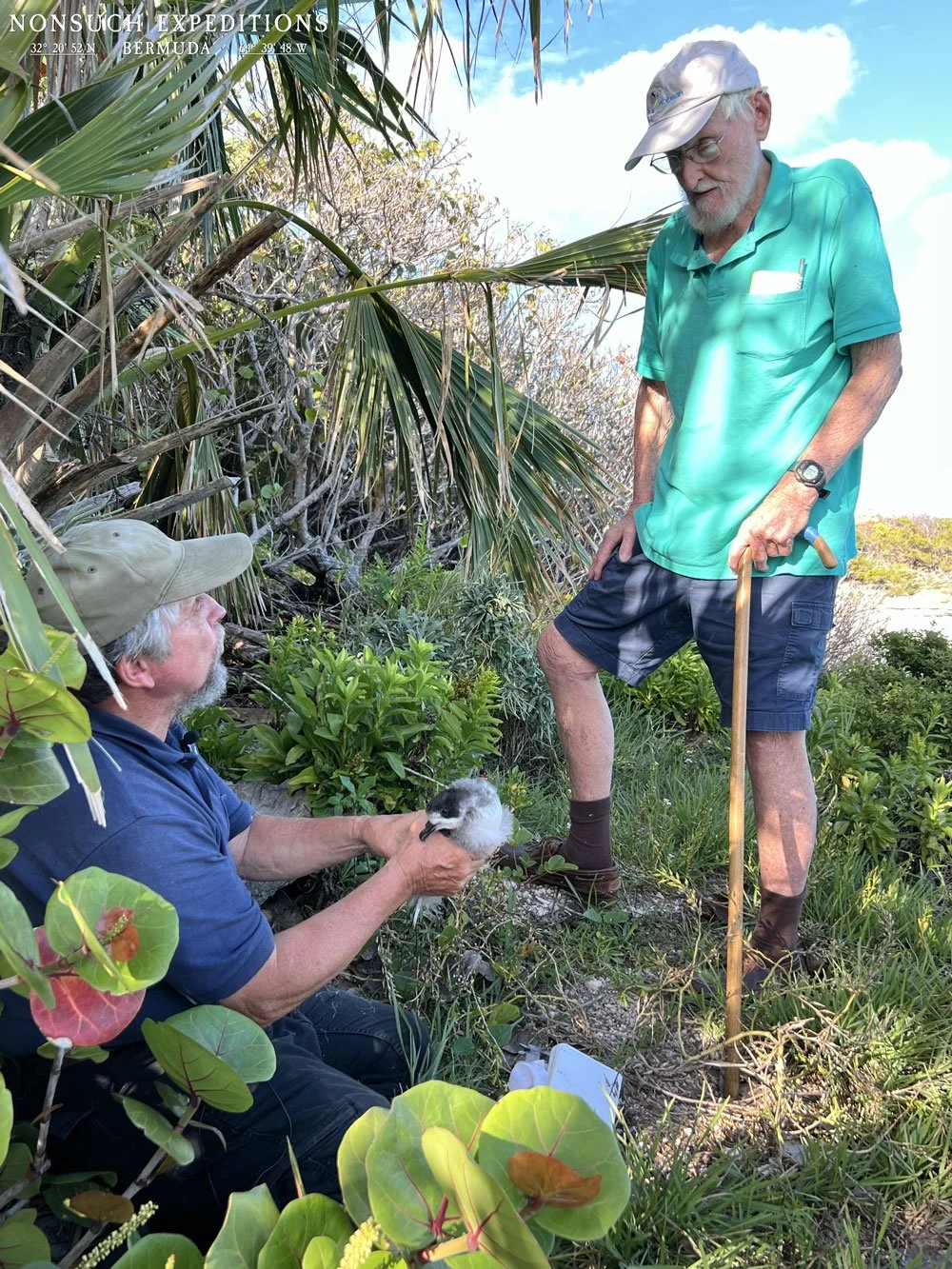
In June of 2023 David was out on Nonsuch with his daughter Rosalind and a group of students for her annual pond clean up, and we took this opportunity to take him out to Colony B where I showed him some of the nesting birds, as well as the first known natural Cahow Nonsuch nest in over 300 years.
Then in 2024, Rosalind and I were able to organize a group to bring a now physically ailing David out to Nonsuch for a night watch to see the growth of the new translocation breeding colonies that I was able to establish on the island between 2004-2017, and that had grown to nearly 40 breeding pairs. After helping him down to the colony site, on the coastal hillside of Nonsuch looking out to sea, and settling him into a low chair, as luck would have it, as soon as night fell we had an exceptional number of Cahows fly in and start swirling around the colony, clearly visible as silhouettes against the glow of lights from nearby mainland Bermuda. I counted almost 40 Cahows in the air at one point, with some coming down to flutter curiously in front of David as he sat in his low chair. I remember him saying that he had never imagined that he would see them nesting in such numbers on Nonsuch in his lifetime, and that their numbers would have increased so much.
I feel very fortunate that he was able to see this, as it is my firm conviction that if not for David, the Cahow most likely would have become extinct by the early 1970s, and that Nonsuch would have likely either become a millionaire’s retreat or a marina for the Tucker’s Town area (a proposal that was seriously considered in the late 1940s/early 1950s, before the rediscovery of the Cahow, according to David).
The last time I was able to talk with David was on the 24th of July this year, when I visited him at his home with Dr. Andre Raine, another young Bermudian mentored by David and now working with Archipelago Research and Conservation out of Kauai, Hawaii, his wife Helen, and filmmaker Dierdre Brennan, who produced the documentaries “Bermuda’s Treasure Island” and “Skellig and Bermuda”, featuring Nonsuch Island, the Cahow and the translocation project. It was great to talk to him, update him on what was happening, and give him the latest annual report on the Cahow Recovery Program.
When I received the news from Rosalind on Tuesday about his passing, I was just preparing to go out to Nonsuch to meet with British Seabird expert Bob Flood, who has been bringing groups of avid seabird enthusiasts and birders to Bermuda since 2012-1014, specifically to see & photograph Cahows at sea and at their breeding colony on Nonsuch, where I can involve them in my banding and measurement studies of the Cahows nesting there in artificial nest burrows. Although I was a bit overwhelmed still by the news, I was able to inform the group of the legacy of David represented by Nonsuch and the nesting Cahows, which have now increased to a total of 166 breeding pairs this year on all nesting islands, and we observed a minute of respectful silence before proceeding with the tour. I like to think that David was still there with us, looking over our shoulders as I brought some of the birds out of their burrows to weigh, check band numbers and body condition with the group, beaming with pride at the success of his adapted “feathered foster children” and the home island that he spent 40 years restoring to eventually become their home again.
I could not think of a better group to be with, and a more appropriate way to celebrate the life and achievements of my old mentor and friend. RIP David, and thank you for all of your guidance and work in protecting Bermuda’s natural heritage.”
Jeremy Madeiros
Senior Conservation Officer – Terrestrial Conservation - Dept. of Environment and Natural Resources - BERMUDA