

This past season 8.5 million minutes of CahowCam video were watched by our viewers from around the world, see highlights below (be sure to turn on audio using button in lower right of player).
CahowCam viewers watch more than 8 million minutes of video during 2017 nesting season.
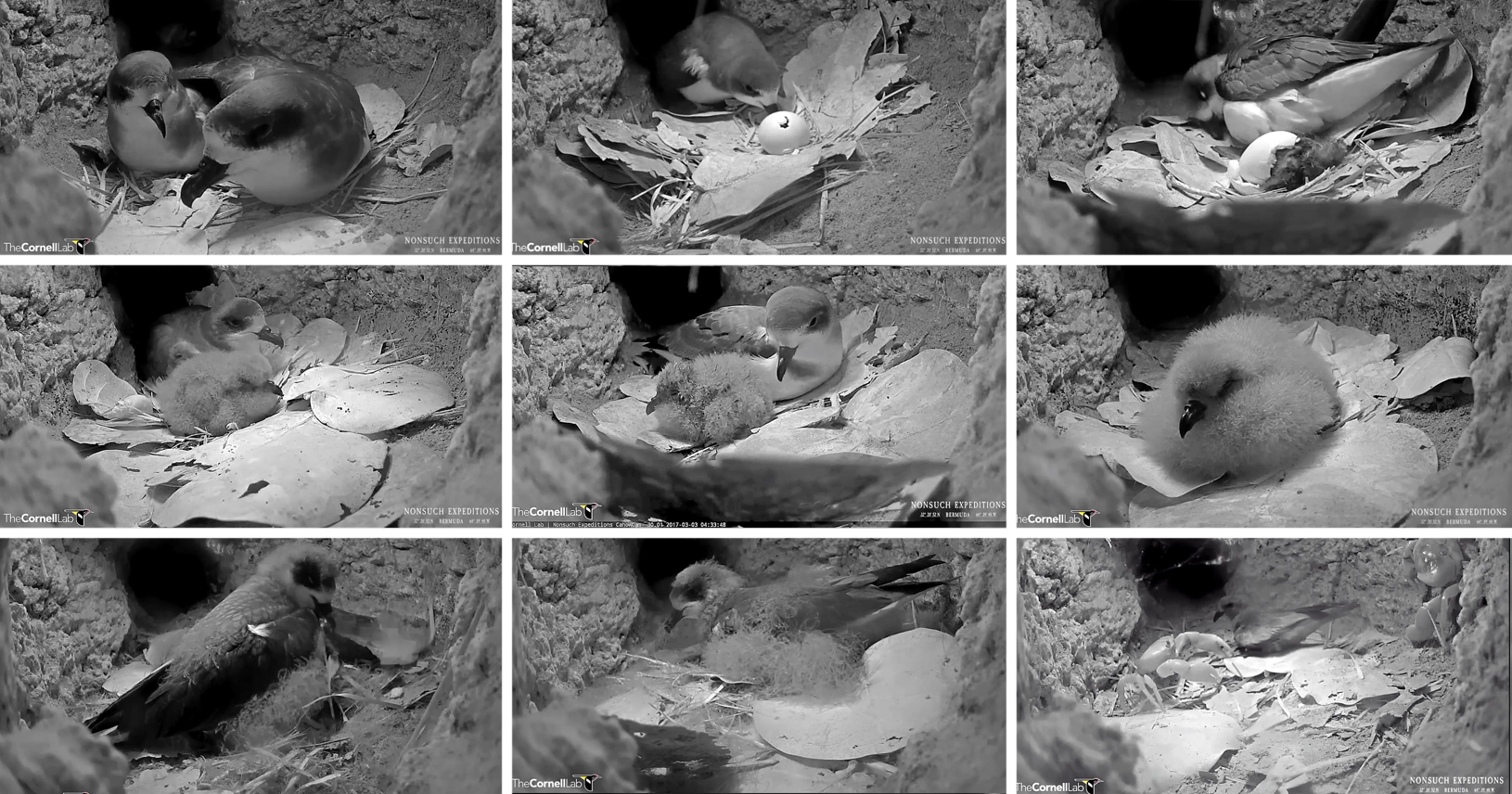
The Nonsuch Expeditions CahowCam has now ended its 5th season broadcasting live from the underground Cahow nesting burrows on Nonsuch Island. This year its new partnership with the Cornell Lab of Ornithology resulted in 600,000 views for a total of 8.5 million minutes of video being viewed by scientists, students and followers from around the world.
Jeremy Madeiros, Senior Terrestrial Conservation Officer and Cahow Recovery Program Manager: "The Cahow Recovery Program represents a long-term commitment by the Bermuda Government towards the conservation and recovery of the island's National Bird. it represents one of the most successful programs for the recovery of a critically endangered species, and has endeavored to make use of new technology and management techniques whenever possible. Public outreach and education is one of the main objectives of the recovery program, and the CahowCam project and partnership with the Nonsuch Expeditions has contributed greatly to the achievement of this objective. In addition to bringing the story of the Cahow's survival and recovery to an international audience, it has enabled previously unknown aspects of the breeding biology and behavior of the species to be observed."
Charles Eldermire, Bird Cams Project Leader, Cornell Lab of Ornithology: "This season working with Nonsuch Expeditions to showcase the Cahow to a broader audience was a great success, reaching hundreds of thousands of viewers and raising awareness about the ongoing need for investment in the cahow's future. The foundation we laid through our partnership this year will allow us to continue improving the quality of the online experience in future years, and to further highlight the efforts of the Bermuda Department of Environment and Natural Resources."
Jean-Pierre Rouja, CahowCam designer and Nonsuch Expeditions Team Leader: "This project is a perfect example of how we aim to combine technology and media to assist and participate in conservation, research and educational outreach. What started out as a media-driven educational outreach project has now evolved into an extremely effective conservation tool, contributing greatly to the protection and recovery of the species."
There have been many examples over the past few seasons where the 24/7 live view of the up until now unknown nesting behaviors of one of the rarest seabirds on the planet is allowing the Team to re-write what is known about their behaviors and how they interact with each other as a colony.
The CahowCam stream has also allowed the Team to effectively crowdsource the monitoring of the 24/7 feed enabling viewers from around the world to watch, log and capture significant events that would have otherwise been missed.
Summary of 2017 Record Breaking Cahow (Bermuda Petrel) Breeding Season
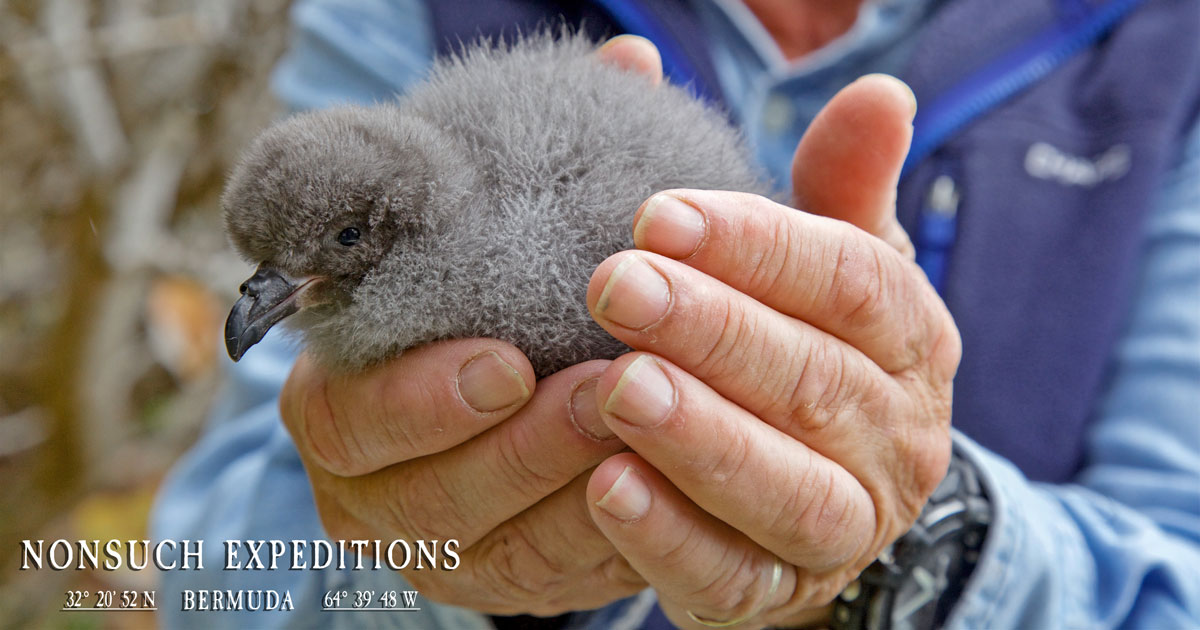
Compiled by: Jeremy Madeiros, Cahow Recovery Project Manager, Senior Terrestrial Conservation Officer, Department of Environment and Natural Resources, BERMUDA GOVERNMENT

The most recent nesting / breeding season for the Critically Endangered Bermuda petrel, or Cahow, which is Bermuda’s National Bird and one of the rarest seabirds on Earth, began in late October 2016, and ended on the night of 27/28th June, 2017, when the last Cahow chick fledged out to the open ocean, not to return for several years. The Cahow is endemic or unique to Bermuda, nesting no-where else on the planet. It is pelagic, spending most of its life in the middle of the ocean, and returns to land only to breed, laying a single egg annually. It nests on only 6 small islands totaling only 20 acres, in the Castle Harbour Islands Nature Reserve, where it is protected by wardens and is the subject of an intensive management program.
Overall, during this breeding season, the Cahow has continued its positive upward trend in both the number of established breeding pairs and overall size of the population, and in the number of successfully fledged chicks being produced by the nesting pairs.
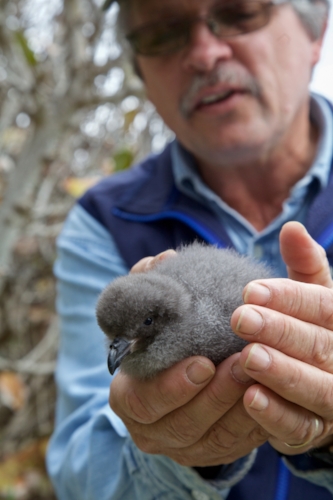

When active management of the Cahow and its tiny offshore nesting islands began around 1960, the entire population consisted of only 17 to 18 breeding pairs, producing a total of only 7 to 8 chicks annually. The population faced many threats and challenges, including predation by introduced rats swimming out to the nesting islands, lack of suitable deep nesting cavities, nest competition by the larger White-tailed tropicbird or Longtail, which took over nest burrows and killed the defenseless Cahow chicks, and light pollution from the nearby Naval Air Station (now Bermuda International Airport), which disrupts the night -flying cahow and disorients the chicks when they depart to sea.

The 2017 nesting season saw the Cahow nesting population increase to a record number of 117 established breeding pairs (those that produced an egg, whether it hatched or not). In addition, a record number of 61 chicks successfully fledged out to sea (the first time the number of fledged chicks has exceeded 60). These numbers have probably not existed since the 1600s, when the formally abundant Cahow was decimated by the arrival of human colonists on Bermuda, through overhunting and predation by introduced mammal predators such as pigs, rats, cats and dogs.
In addition to the encouraging continued increases in breeding pairs and fledging chicks, a record number of over 10 newly establishing, prospecting pairs was recorded, most of which should produce their first eggs and come “on-line” as breeding pairs next season.
Since one of the major threats facing the Cahow has been erosion and damage to their original tiny breeding islands by repeated hurricanes, which produce huge waves that completely submerge the smaller islands and rip huge chunks of rock away. Their small size also severely limits the number of breeding Cahows that can nest on them. To address this, one of the main objectives of the Cahow Recovery Program has been to establish new Cahow nesting colonies on larger islands that are safe from hurricane erosion and have more room to enable the Cahow population to grow. The islands also must be constantly managed and wardened to eradicate predators such as rats, and control human access to prevent disturbance.
Nonsuch Island was chosen as the site to establish a new Cahow nesting colony, as it is managed to exclude rats and other invasive species and is the site of a warden’s residence. Cahows were eradicated by the early colonists on Nonsuch, and had not nested on the island since the 1620s. Translocation is a technique in which chicks are removed from their original burrows on the smaller islets and moved to artificial burrows on Nonsuch, where they are hand-fed daily and allowed to imprint on and fledge from their new site. Cahow chicks were moved for 5 years during 2004-2008 to Nonsuch and fed until they fledged to sea. This technique worked and almost half of the translocated birds returned 3 to 6 years later to choose nest burrows and mates. By 2017, the number of nesting pairs at this new colony site increased to 16, with 8 chicks fledging from this area.

This project worked so well that in 2013 a second translocation program was started, to establish a second colony at a different location on Nonsuch. During the 2017 season, 14 Cahow chicks were translocated to Nonsuch, bringing the total number of chicks moved to this second site up to 65. In addition, during 2017 the first three Cahows moved to this site as chicks during 2013 and 2014 returned and started to occupy nest burrows at this second site, with one new pair confirmed, and it seems likely that this signals that the formation of a second new colony is underway.
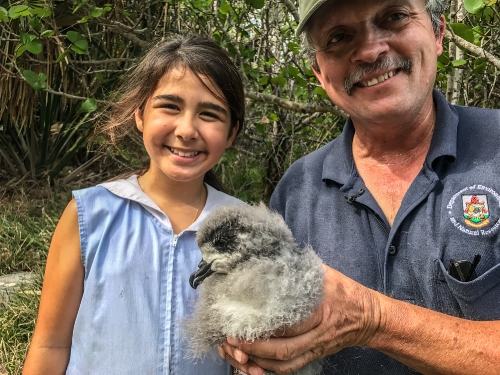
Junior Explorer Sophie names "Shadow" the 2017 CahowCam Star.
Other threats to the Cahow that have been encountered include the invasion of Nonsuch by rats swimming over from the main island during 2016. These were eradicated by the use of rodenticide bait by November 2016, but this has highlighted the need for constant monitoring and vigilance to prevent further invasions by rats swimming out to the nesting islands. In addition, hurricane “Nicole” hit Bermuda directly in October 2016, submerging two of the smaller nesting islands but causing only limited damage. In early June 2017, one of the translocated chicks was stung to death by a swarm of honeybees that occupied its nest burrows, but this swarm was removed shortly after by the Government Agricultural Officer.
Despite these threats, the Cahow population has continued to increase and recover from the edge of extinction. Due to the Recovery Program and the intensive management and control of threats to the species, the future of Bermuda’s unique National Bird looks increasingly positive.
During this Season, the Nonsuch Expeditions CahowCam, now in partnership with the Cornell Lab of Ornithology streamed 8.5 million minutes video, to scientists, students and followers around the world. The real-time, 24/7 window into the Cahow's underground nesting chambers is allowing the team to confirm and in some cases re-write what is know about the Cahow's nesting habits and is contributing greatly to the recovery of the Species.
Stormy the "Loneliest Petrel" battles land crabs and wins!

In the early hours of July 3rd the CahowCam documented its' new resident, a very lost Storm Petrel holding his ground against two native red land crabs during a home invasion. Now named "Stormy" he is back for the second year attempting to attract a mate to the recelenty vacated Cahow burrow on Nonsuch Island. This year he first arrived in early June and as last year seems to have stayed for about a month, building a nest and calling out nightly from the entrance for a mate, before giving up. If he returns the team plans to band him and possibly help attract a mate.
These land crabs use their pinchers primarily for defensive purposes and usually scavenge the abandoned nests helping to clean them out at the end of each season. Stormy was clearly not worried and bit one of them before they gave up and left.
CahowCam viewer alerts team to flesh eating worm landing on Cahow chick.

A case study of Crowdsourcing the monitoring of the CahowCam and other Wildlife Cams.
The Nonsuch Expeditions CahowCams have once again this year been live streaming for 6+ months from the underground Cahow burrows on Nonsuch Island. Whilst these 24/7 video streams present many opportunities to learn more about our subjects, it is impossible (and unrealistic) to expect our small team to be monitoring them 24 hours a day, 7 days a week for 6+ months, and invariably significant events are missed.
This year our online viewers watched over 8.5 million minutes of CahowCam video over the 6 month period, all logging in when their schedules permit from different time zones around the world. This resulted in there being multiple if not hundreds or thousands of viewers online at any one point in time, and given the right tools they were able to log and and report significant events to us which we could then re-confirm by going back to the video archive being created at Cornell.
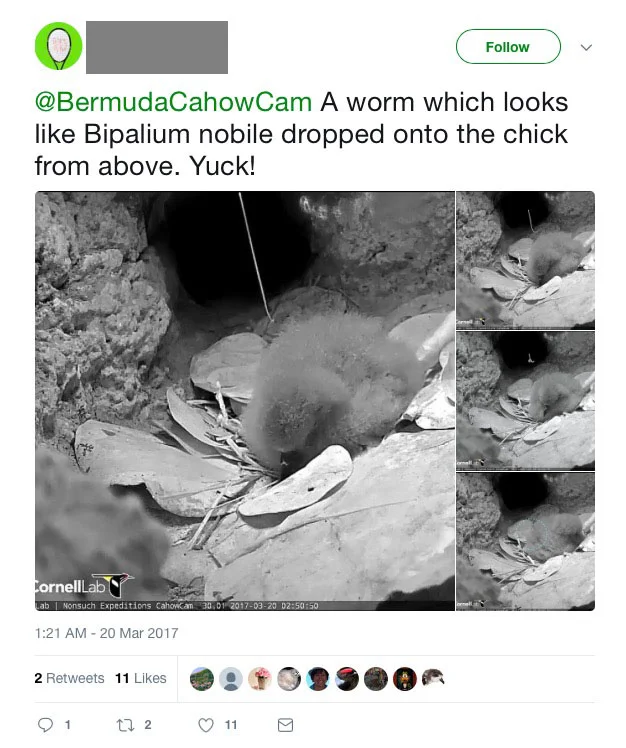
As a perfect example, on March 20th 2017, at 2:50 am local time, a planarian flatworm (possibly the snail eating variety) dropped from the roof onto the back of our Cahow chick. Our local Team was online but not watching at that exact moment, however one of our regular viewers who lives in Japan, was not only watching but recognized that this was something to possibly be concerned about and tweeted to us and other followers tagging our @BermudaCahowCam Twitter account including video frame grabs showing the intruder.
Bermuda is known to have three varieties of flatworms, two of which are flesh eaters that will for example kill and eat snails. The variety known to be on Nonsuch targets primarily earth worms, however there was concern that if this one was of the snail eating variety it might somehow harm the young Cahow chick. Alerted by our Twitter feed we woke up Jeremy who started preparing to go to the boat to rush out to Nonsuch to remove the worm, whilst in parallel we reached out to our partners at Cornell to review the high resolution footage of the intrusion.
Fortuntaley Cornell was quickly able to confirm from their higher resolution video that the worm could be seen exiting the burrow via the tunnel a few minutes after it arrived so the "crisis" was averted, nonetheless this is a very good example of how we can and should crowdsource our followers to help monitor these feeds. There were in fact many other never before documented incidents captured this season including an adult Cahow intruder that almost killed, our at the time, very young chick.
This year once "Shadow" fledged and the season officially wrapped up, we left the camera running to document what would happen to the nest after the Cahows left, and sure enough, as first documented last year, a very lost Storm Petrel moved in to make a nest and try to attract a mate. As much of this activity happens between midnight and 5 am our Citizen Scientist followers are again helping log his activities including a "battle" with two crabs that we might otherwise have missed.
For Second Year, Leach's Storm Petrel documented setting up nest on Nonsuch Island, broadcast live by CahowCam

2017 UPDATE at 3:15 am on June 13th during a thunderstorm "Stormy" returned to the Nonsuch Burrow, when he should be in the Canadian Maritimes.
See the 2016 News Alert:

June 18th 2016: The Cahow nesting season which is winding down, has thus far produced record numbers from the Nonsuch Island Colonies with 6 out of a total 10 chicks having fledged so far and is on track to produce the 2nd highest number of fledgelings from the whole colony, with 58, just down from 59 in 2014.
Recently named “Tempest” the star of the CahowCam livestream, attracted the largest audiences in the CahowCam’s 4 year history with over 6,000 viewers around the world watching live when he hatched and with 10’s of thousands watching his progress over the following 91 days.
J-P Rouja from the Nonsuch Expeditions Team said:
"This year we left the camera running after the chick had fledged on June 5th to see what happens immediately after the burrow is abandoned, and sure enough as happened last year within an hour a land crab made its way into the burrow to start feeding on the nesting materials.
To our utmost surprise however around 4 am a small petrel looking seabird first called into and then entered the chamber as if prospecting for a new nest site. This bird was less than half the size of a Cahow with a different vocal pattern so we knew it was something new. He spent about an hour rummaging around and then departed before sunrise leaving all of us who were watching online not sure what we had just witnessed and thankful that it had been recorded."
Chief Terrestrial Conservation Officer Jeremy Madeiros initially pointed us towards the Storm Petrel family, which is of the same nocturnal, burrow nesting tube nosed family as the Cahow, however none of these are known to have ever landed or nested in Bermuda, let alone be filmed doing so.
The Nonsuch Expeditions Team digitized the video and the audio recordings so that they could be shared amongst the local and international birding community experts and the consensus thus far confirms Mr. Madeiros’s suspicion that it is the dark rumped variation of a Leach’s Storm Petrel. These normally nest 800 to 900 miles away in the Canadian Maritimes and are less than half the size of Cahow with a wingspan of 19” versus 36” to 38” for a Cahow.
Jeremy Madeiros says:, "We all thought we had witnessed an amazing one off event, however the CahowCam has allowed us to witness two more 3.30am visits as this little bird who seems to be intent on occupying this nest and attracting a mate. The odds of this bird not only deciding to nest in Bermuda 800 + miles from home but also happening to pick the one burrow where we have a camera operating must be a million to one, but now that he is here there is actually the remotest possibility of him succeeding in attracting a mate as the species is known to feed in our open ocean waters.
This is a great gift for today, World Ocean’s day, as it shows that even as we increase our understanding, there is so much more to learn."
What is now evident is that through the ongoing successful management and protection of the slowly increasing Cahow colony there are other positive unintended consequences such as encouraging other species to nest here as well.
As of 4.30 am on June 8th “Stormy” as he is now nicknamed was sitting in the entrance of the recently vacated Cahow burrow on the edge of a cliff on Nonsuch Island calling out to sea for a prospective mate, whilst unknowingly connected to the digital world.
Please login to www.nonsuchisland.com/live-cahow-cam/ for replays and updates or watch live at 3.30 am or so tomorrow morning if you are awake and so inclined.
Best of luck Stormy on a rather stormy World Oceans day. :)
UPDATE: June 9th He visited again between 2 am and 4,30 am arranging the nest and calling out for a mate.
UPDATE: June 10th He is back again!
UPDATE: June 17th He is back yet once again! Virtually every night for the past 12 days!
Shadow the 2017 Cahowcam star has fledged!

On World Oceans Day the Nonsuch Expeditions and Cornell Lab of Ornithology Teams are pleased to announce that "Shadow" the star of the 2017 CahowCam successfully fledged out to sea on June 5th after exiting the burrow at around 11 pm.
Here is the last Video Health check and the naming of "Shadow"
Meet the 2017 Cahow Easter Chicks!

Jeremy Madeiros | As we prepare to celebrate Easter, I continue to be very encouraged and hopeful for the continuing recovery of one of the world's rarest seabirds.
As for the whole breeding population, the number of breeding pairs rose slightly to a record number of 117 pairs, up from 115 in 2016 (for those producing an egg, whether it hatched or not). The number of chicks at the present time (April 15th) is at least 62, although it is likely that we will loose at least a couple of those before they are ready to fledge to sea in late May/early June. Still, we have a good chance of breaking the present record of 59 fledged chicks in 2014 ( the number of successfully fledged chicks for last year's season (2016) was 56).
Perhaps the most encouraging statistic so far from this year's breeding season is that at least 9 to 10 new nests are being prospected by newly matured, young Cahows returning to the nesting grounds for the first time since fledging, with establishing pairs confirmed in most of them. Since most of these birds were fitted with identification bands while still in the nest, we know that they fledged to sea as chicks 3 to 5 years ago, and have since lived on the open ocean out of sight of land until their return this year. These potential new nesting pairs should hopefully produce their first eggs in the next breeding season in 2018 and come "on-line" as breeding pairs. As we prepare to celebrate Easter, I continue to be very encouraged and hopeful for the continuing recovery of one of the world's rarest seabirds.
The weight of the CahowCam R831 chick on Thursday was 302 grams, while the wing chord was 67mm (he was also fed again that night by the female bird, so obviously has gained weight again following that feeding).
April 13th Cahow health check Video
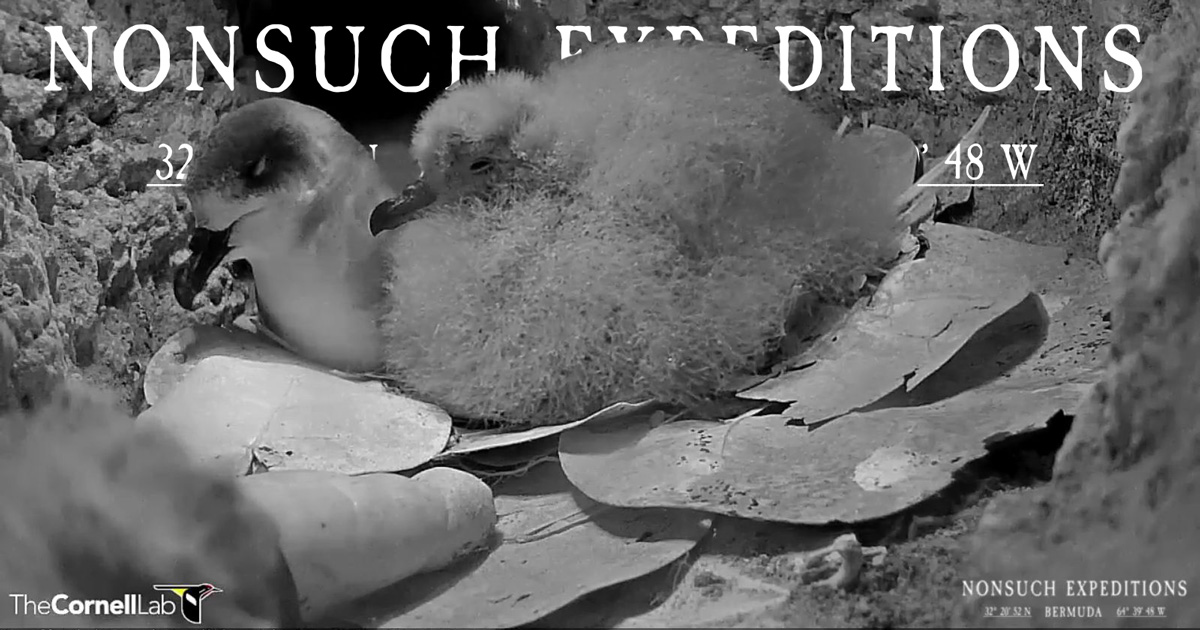
The CahowCam star chick is growing nicely!
Its' weight on Thursday the 13th of April was 302 grams, while the wing chord was 67mm (he was also fed again that night by the female bird, so obviously has gained weight again following that feeding).
Cahow chick weight gain - loss - gain fluctuations

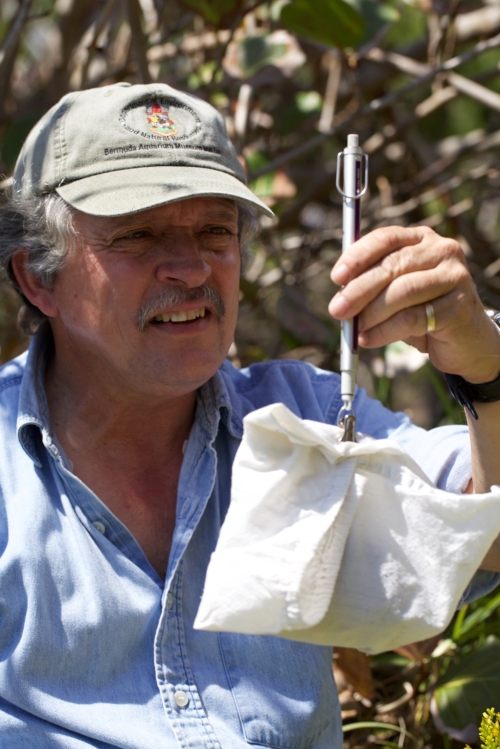
The Bermuda petrel (Cahow) chick continues to grow and experience all of the challenges that a young petrel chick must go through during the course of its long, 3-month or more development period.
After hatching on March 2nd, the chick was fed by both the female parent on the 6th March, and the male parent, just after hatching and again in the pre-dawn hours of 8th March.
The following week was the period leading up to the full moon, when parental feeding visits often drop off as the extra light discourages the Cahows, which are nocturnal over the breeding grounds, from visiting the nests. As a result, the chick was not visited or fed for 6 days, until the female parent finally returned to the nest in the predawn hours of March 14th, under cover of cloudy, stormy weather, staying over for the day in the nest burrow with the chick and feeding it at least 4 separate times.
Although many viewers have expressed concern about the length of time that the chick was left on its own, this is completely normal for the Cahow and chicks can be on their own for a week or more between visits, with no lasting ill effects.
Cahow chicks, like those of other seabirds in the tubenose seabird family, which includes Albatrosses, Shearwaters and Petrels, are precocious, or quite highly developed when they hatch (which is one of the reasons the egg incubation period is so long), and are equipped with coats of long, dense down which enable them to keep warm and survive on their own in cold, damp underground burrows without needing the adults after the first 2 or 3 days.
The adults indeed have to spend almost all of their time out at sea finding enough food, or the chick will starve. These chicks take about 3 months (about 90 days) to fully develop, and then fledge to sea on their own, with no parental help or instruction. They then must learn to survive, find and catch food, out on the open ocean on their own, in about a 10-day period after fledging before their own fat reserves are exhausted , or they will not survive. Life for the Cahow is not easy, and it is a testament to what tough survivors they are, that they not only survive in one of the toughest environments on Earth (the open ocean), but are also recovering (with a bit of assistance!) from what can only be described as the very edge of extinction.

After the full moon on the 12th of March, we expected to see an increase in adult feeding visits, and that was just what happened. The female parent visiting on the 14th, 17th, 21st and 22nd March, a couple of times staying over the next day with the chick in the nest, while the male adult has visited on the 15th and 20th March.
It appears that the female has located a prey-rich foraging area much closer to the island and so has a shorter return time, while the male is going much further away to gather food on a approximate 5-day rotation.
This male had been fitted with a geolocator tag for 2 years back in 2009-2010, and we know he generally travelled well away from Bermuda, ranging from just south of Nova Scotia to 1500 miles northeast of Bermuda (two-thirds of the way to the Azores Islands!), so I suspect that is the approximate area where he is going now.
All of these feeding visits have enabled the chick to increase rapidly in weight, from just 52 grams on March 13th, to 153 grams just 2 days later on March 15th, and to 192 grams on March 22nd.
This increase/decrease in the chick's weight as it develops is a normal part of it's development, and I expect we will see another temporary decrease in the next full moon period, approximately the 5th to 11th April. However, stormy and cloudy weather may also enable the adults to sneak in, so you never can tell. If the chick continues to develop normally and is adequately fed by the adults, we can expect to see its weight increase to 300 grams or more by the end of April. The current record peak weight for a Cahow chick was 557 grams, almost double the weight of an adult! More normal peak weights for chicks however range from 330-430 grams, and last year's CahowCam chick reached a peak weight of 435 grams on May 18th. After reaching their peak weights, feeding visits by the adults become fewer and the chick completes its development using its fat reserves accumulated earlier in their growth, going through a "slimming down" period before fledging to the open ocean at a normal weight range of 250 - 300 grams.
UPDATE March 26th: The weight of the R831 chick today (Sunday March 26th) was 151 grams, while the wing chord was 40mm. By comparison, on Wednesday (March 22nd), the weight was 192 grams, while the wing chord was 32mm. The most advanced chick on Nonsuch (in the R821 burrow) was 247 grams today with a wing chord of 50mm.
Watch a LIVE Nest Check on the CahowCam - Day 6 Post-Hatch
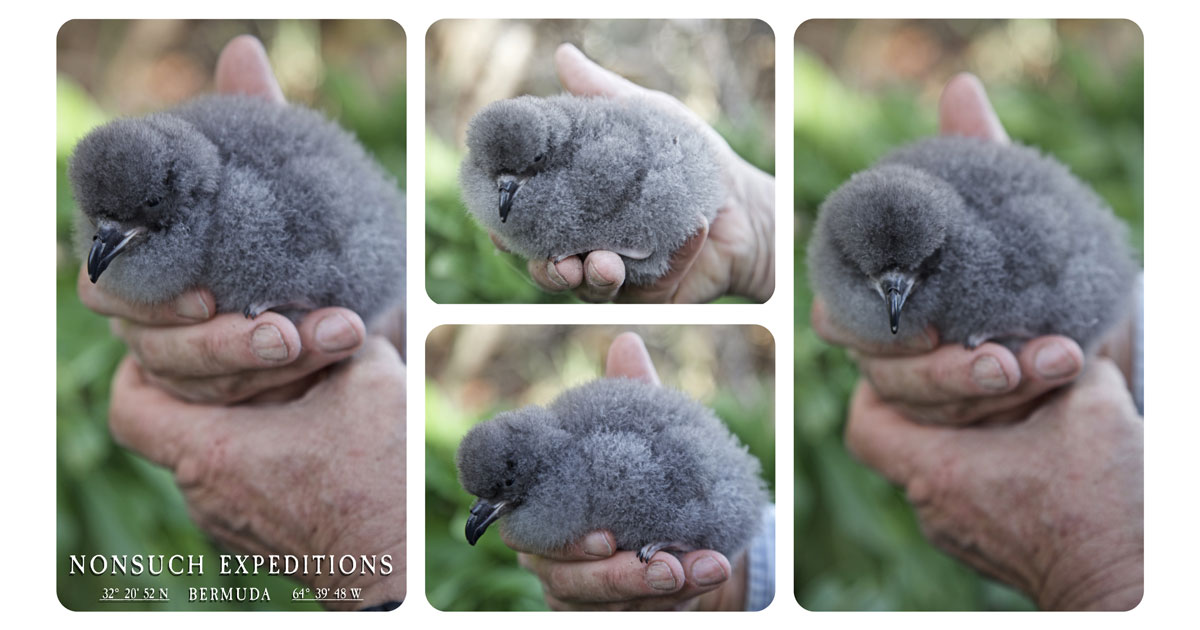
The burrow on Nonsuch Island is opened for a health check of the 6 day old Bermuda Petrel chick by Jeremy Madeiros the Senior Terrestrial Conservation Officer. After a feeding from the adult male last night, the chick looks healthy and is gaining weight.
After a scare from a prospecting Cahow on March 6th, the chick was fed by the female parent on March 7th and the male in the early hours of March 8th and is now up to 83 grams from 72 grams the day before.
Watch a video REPLAY below, which is the first in a series that will be broadcast LIVE via the Cornell Lab of Ornithology Network. In this test our Team's focus was the logistics and networking required for live-streaming using solar power and wireless internet from a remote island through to the Cornell Campus. Future episodes will have much higher production and video quality. Educators should CONTACT US and SUBSCRIBE to our Newsletter for more information.
Intruder Alert! Unexpected threat to new Cahow chick.
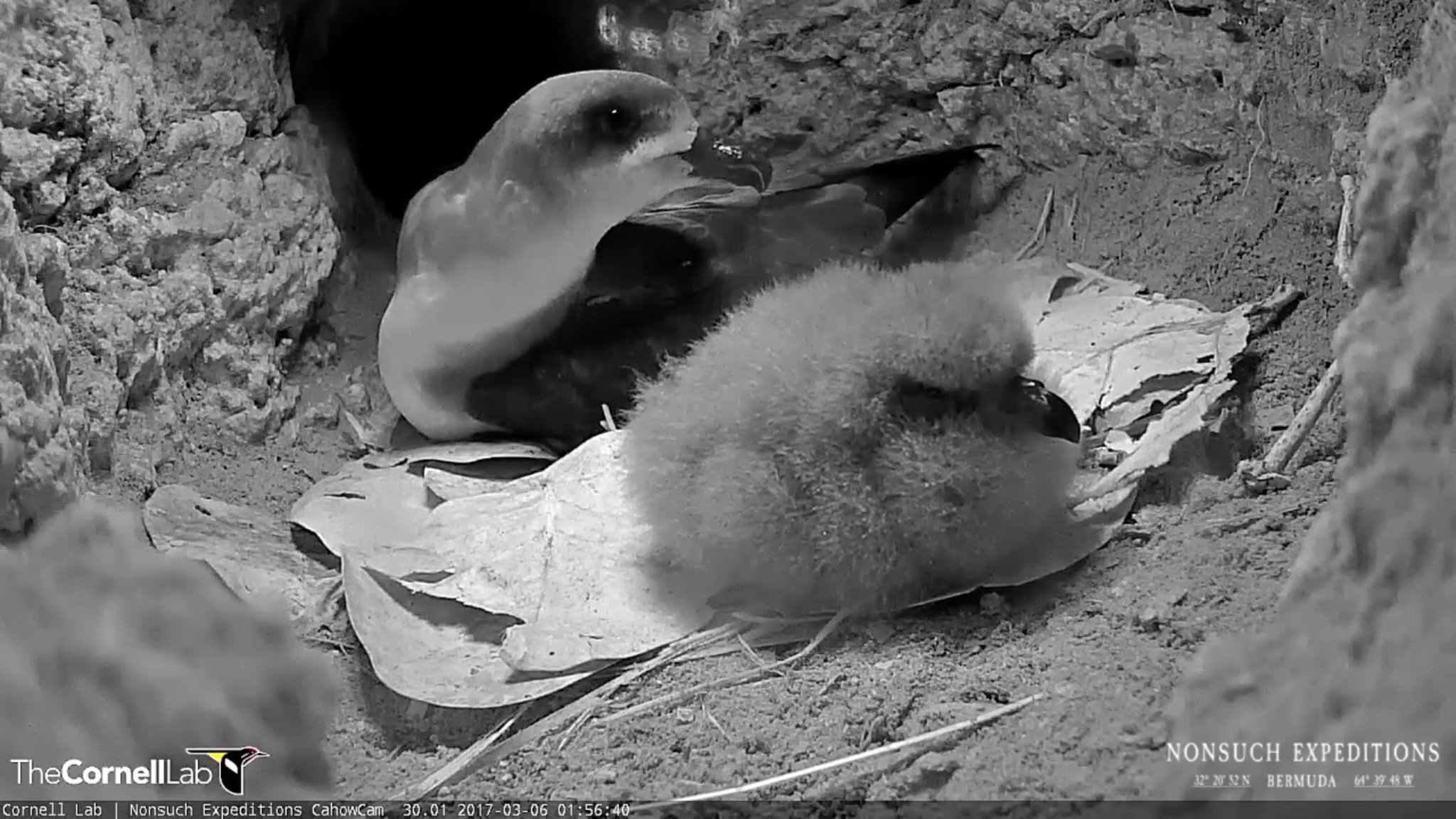
Prospecting adult documented threatening CahowCam chick.
The Cahow chick that hatched on March 2nd in the CahowCam nest on Nonsuch Island has already had an eventful life.
* See update at end of article.
After hatching, the adult male stayed with the chick for two days, feeding it at least three times before flying back out to sea on Saturday evening. Both parents are now into the cycle of lengthy feeding trips to gather squid, shrimp-like organisms and small fish from cooler water hundreds of miles from the nesting islands, and will only be feeding the chick every 3 to 5 days at night for an hour or two before heading back out to look for more food. The chicks are well equipped with their thick coats of warm down to wait for up to a week or more on their own for these brief feeding visits.
On Sunday night/early Monday morning when a adult Cahow appeared in the nest at 1.40am my first thought was that the adult female had returned to feed the chick. It was soon evident, however that something was wrong, as the adult was nervous and edgy and was very aggressive towards the chick; rather than gentle preening the adult was biting the chick quite hard in what could only be described as an attack. Luckily, the chick basically played dead and after 18 minutes the adult left the nest. However, it looked back in at least 3 times over the next few hours, but turned and went back out as soon as the chick began cheeping.
It is now evident that the mystery intruder was in fact a young prospecting Cahow that was looking for an empty nest burrow, which they can be quite aggressive about as it is one of the more important decisions in their lives. This incident however, as revealed by the CahowCam, finally confirms a suspicion about a rather alarming threat to the newly hatched chicks. Every year, I have noted that one or two chicks that appear to be healthy and growing normally during one check are found dead during the next check without any of the marks generally associated with, for example a rat attack. It now appears likely that aggressive young prospecting adults may sometimes get rid of the chick in order to try and take over the burrow.
This chick was lucky to have survived the attack, and indicates that despite all of the management that we carry out to help the Cahow a better chance to survive and recover, that life is still precarious for one of the world's rarest seabirds. Let's hope that the next visitor is in fact one of the legitimate parents coming to feed the chick!
UPDATE March 7th 00:05 am | Fortunately one of the parents seems to have returned the following night for a traditional feeding session.
UPDATE March 8th 01:40 am | For the second night in a row a parent has returned, this time more than likely the male. It should be noted that though the above event was distressing to watch that the Conservation Services Team have mitigated 99% of similar threats to the Cahows through the ongoing suppression of rat infestations on the islands and through the installation of baffles to stop the prospecting Tropic Birds from taking over the nests.
Jeremy Madeiros, Senior Conservation Officer (Terrestrial), Dept. of Environment and Natural Resources, BERMUDA
Hello World! Cahow Chick hatches at 9.45 pm on March 2nd 2017- Broadcast LIVE via CahowCam
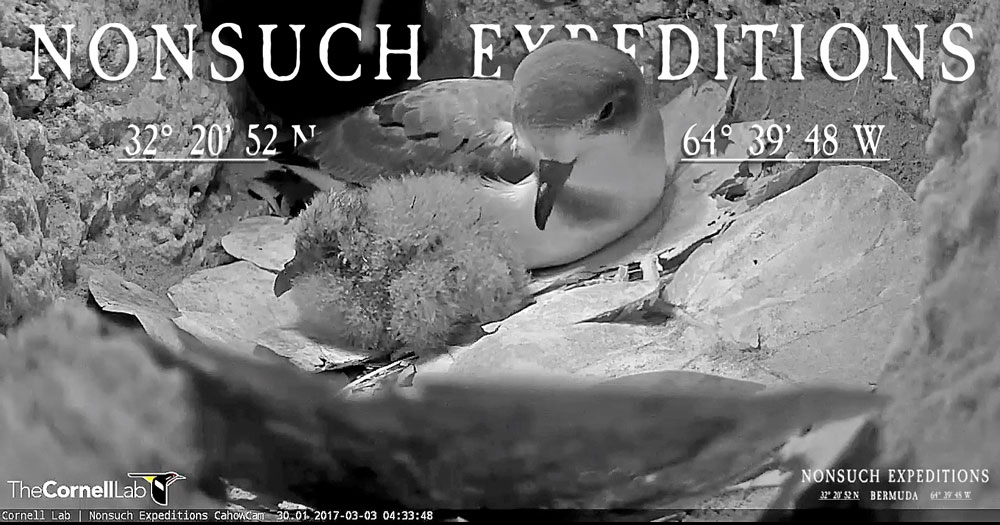
7 hour old Cahow chick, star of the 2017 CahowCam LiveStream
A CahowCam Star is born!
(Watch LIVE CahowCam video here)
On January 11th, 2017, the egg in the R831 Cahow nest burrow on Nonsuch Island was laid less than an hour after the female returned having spent the past few weeks at sea.
Both adult Cahows then took turns incubating the egg, with the female incubating a total of 25 days, the male for 22 days, and both adults together for 4 days.
Faint cheeps from the nearly ready to hatch chick were heard from inside the egg on the evening of March 1st. On Thursday 2nd March, after 51 days of incubation, the chick started to chip its way out of the egg, with the first hole in the eggshell seen around 4.00am.
At about 7.30pm that evening, the male Cahow returned to take over incubation, and was probably surprised to find the chick already hatching! Shortly after the female departed to sea, the chick started to break free of the egg, and by 9.45pm the chick had freed itself from the last of the eggshell, allowing us to officially confirm hatching!
The still-wet chick will be closely brooded by the male bird until it is fully dried out, which should take about 2-4 hours. We should then get a good look at the chick, which will have dried out to become the familiar grey fluffball, insulated by a thick double layer of soft down. This down will enable the chick within 2 or 3 days to be able to survive without being warmed by the adults, which will spend most of their time at sea foraging for food for the chick. The chick will only see the adults for an hour or two every few days when they arrive on feeding visits, after which they return to sea to forage for the chicks next meal. It is not unusual for adults to stay with the chick for a few days, especially when the chick is still young.
Geolocator tags fitted to the adult Cahows have confirmed that they can travel between 1500 and 4000 miles during each foraging trip - to feed the chick once! These foraging trips can last from 3 to 10 days or more and take the adult Cahows to the south of Nova Scotia, up to the Grand Banks or even almost as far as the Azores Islands, with the birds generally looking for food in the cooler waters north of the Gulf Stream. The adults will have to keep this up for the next 85 to 95 days, when the chick is ready to fledge out to sea on its own in late May or early June.
Jeremy Madeiros | Senior Conservation Officer (Terrestrial) | Dept. of Environment and Natural Resources | BERMUDA
Female Cahow lays her single egg - Broadcast LIVE via the CahowCam

Nonsuch Island, Bermuda - 9.45pm Jan 11th - Female Cahow returns and lays egg within an hour, officially launching the 2017 CahowCam season.
Now in their 5th Season, the Nonsuch Expeditions Team have partnered with the Cornell Lab of Ornithology to bring the Cahow story to the world.
And an egg was laid at 22:41 Bermuda time! Congratulations! Let the breeding season officially begin. pic.twitter.com/qIu5DaBysE
— BermudaCahowCam (@BermudaCahowCam) January 12, 2017
The original CahowCam is installed in the top of burrogh #831, in translocation colony A, on Nonsuch Island in Bermuda, from which it has been broadcasting LIVE via the internet for 4+ years.
This season a second camera has been installed underground on the side of the nesting chamber giving an alternate view of the nest and after several weeks of planning, digging and installation it went fully LIVE the afternoon prior to the females return.
The female was actually a few days earlier than expected as last year she returned on the 15th, however at 9.45 pm our Team received a motion alert and promptly logged on to observe.
Both Chief Conservation Officer Jeremey Madeiros and Cornell's Charles Eldermire were watching (and recording) LIVE as she spent the first hour rearranging her nest and then promptly laid here single egg.
Jeremey Madeiros - January 11th
Exciting night as I watched the female E0197 bird enter the nest at 9.45pm. After building up the nest to its liking, the bird settled in and at 10.43pm abruptly lurches forward off the nest almost into the camera lens, revealing a newly-laid, glistening wet egg - less than an hour after arrival!
Nonsuch Expeditions CahowCam partners with Cornell Lab of Ornithology
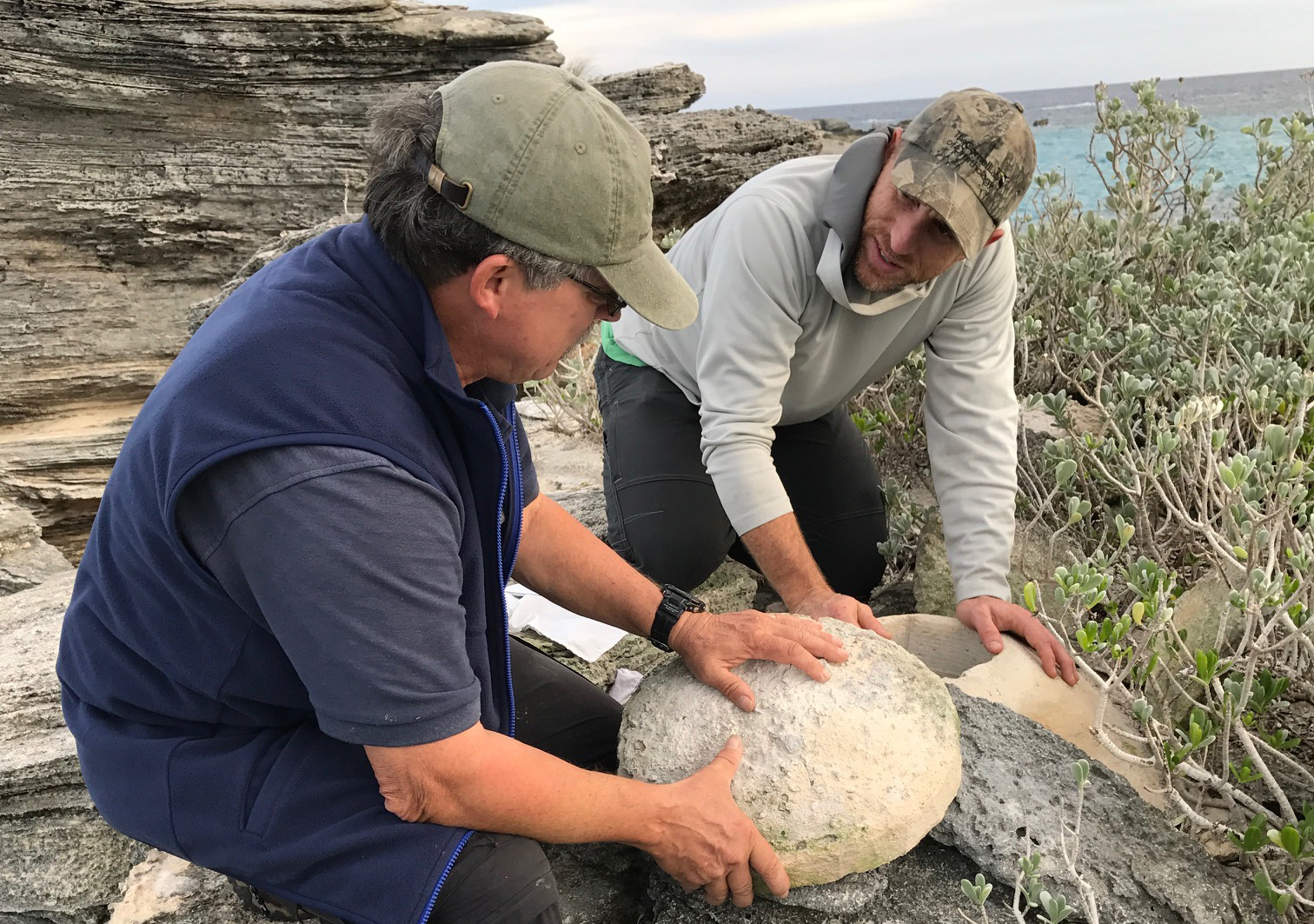
Terrestrial Conservation officer Jeremey Madeiros and Cornell's Charles Eldermire examine an artificial Cahow burrow.
Over the past four Cahow nesting seasons, LookBermuda’s award-winning Nonsuch Expeditions CahowCam has grown from strength to strength, broadcasting from the underground nesting chambers of the second rarest seabird on the planet: the critically endangered, endemic, Bermuda Petrel or “Cahow”. Numerous "first time documented" events were filmed during this period including the hatching of a Cahow chick that was live streamed to the conservation team, bird watchers and classrooms around the world.
Nonsuch Expeditions leader and CahowCam designer J-P Rouja: "Whilst our worldwide audience has been growing organically from year to year, with several thousand viewers watching when the chick hatched this past spring and several hundred thousand minutes of video streamed throughout the season, we have been doing this completely on our own."

To take this to the next level we reached out to the Cornell Lab of Ornithology's Bird Cams project, an effort that has created an extensive network of live streaming cameras with an audience of millions of viewers and an emphasis on education and research. We're excited to announce that Nonsuch Expeditions will be partnering with the Cornell Lab for the 2017 CahowCam season, allowing us to bring a renewed focus on the Cahow conservation efforts in Bermuda while providing a more robust streaming experience and greater exposure to new audiences.
The Cornell Lab's Bird Cams project leader Charles Eldermire was very positive when we proposed the partnership, remarking that, "Given their precarious future and their out-of-sight lifestyle, the Cahows seemed like a perfect fit for the Bird Cams. The previous efforts and expertise of the Nonsuch Expeditions team made us even more confident about the opportunity that this partnership presented."
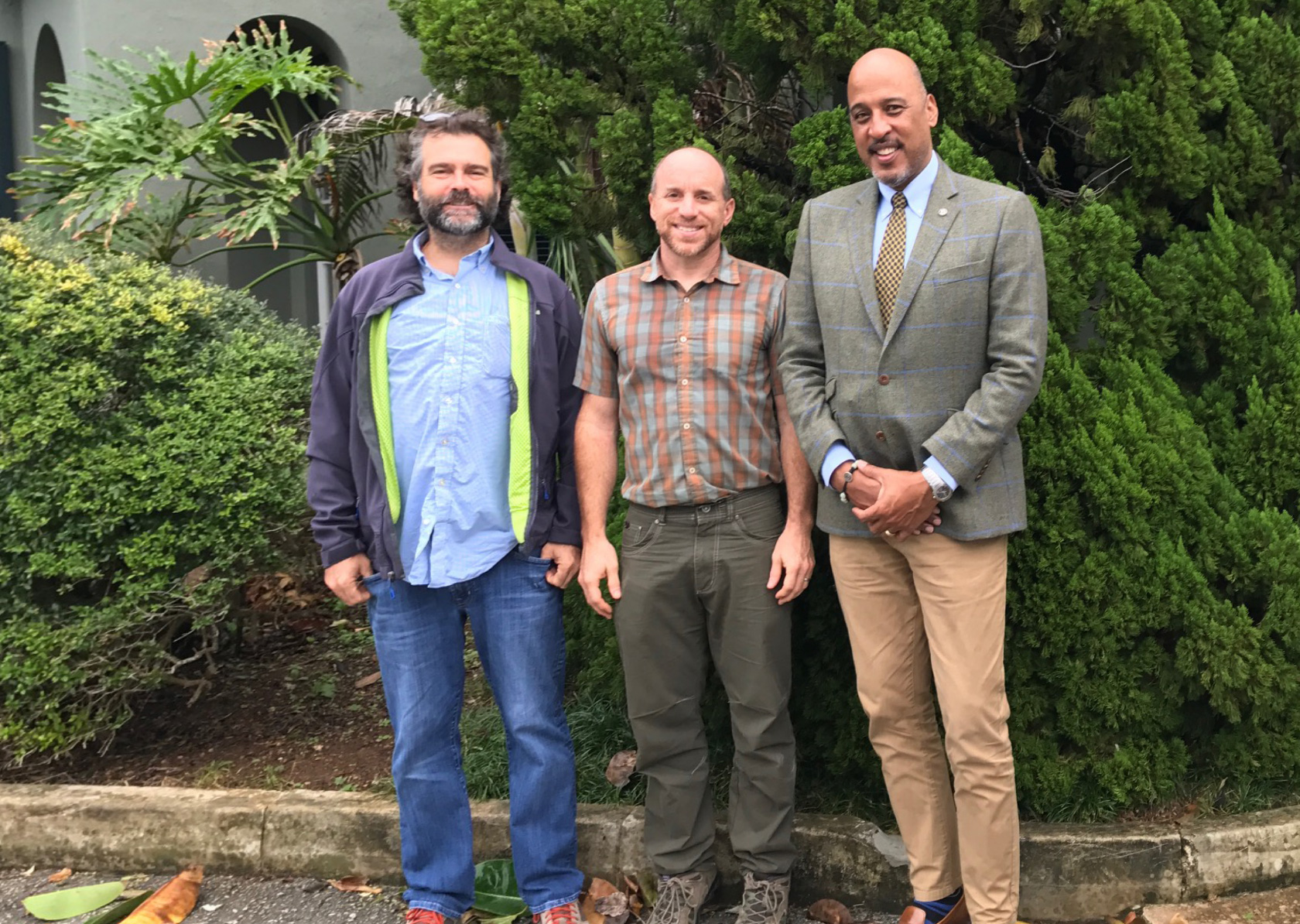
J-P Rouja, Charles Eldermire and The Hon. N. H. Cole Simons, JP, MP
Eldermire visited Bermuda this past November to get a better idea of the scope of the Cahow conservation effort. During three days of meetings, checking nests, and troubleshooting technology, he met with important stakeholders and leaders for Cahow conservation and consulted with Department of Conservation Services biologists and Nonsuch Expeditions team members to help develop a plan for the coming season.
"We're really excited to be sharing the hidden world of the Cahows with an even wider audience, and to collaborate with the Nonsuch team to create meaningful experiences for viewers that raise awareness about the continued need for conservation of the species."
As of the posting of this article in mid December, the Cahows had just completed the courtship phase of the upcoming nesting season, having returned to Nonsuch and the surrounding rocks in November for courtship, nest preparation and mating. Thus far this season 117 pairs have been verified putting us on track for a record. The birds have now left for the month of December and the females are expected to return to lay a single egg the first week in January.
Please visit the CahowCam page to view the live video stream and highlights from the past nesting seasons and be sure to sign up to the newsletter for notifications of the upcoming season.
Cahow Translocation Project milestone reached!

The final benchmark for deeming the Nonsuch Island Cahow Translocation Project a success has been reached!

At the start of the 2017 Cahow nesting season, during the courtship activities in November, a new pair was observed building a nest and courting on Nonsuch Island by Jeremey Madeiros, Head Terrestrial Conservation Officer.
The pair consisted of two newly returned fledglings, the male born on Nonsuch Island from parents who had been translocated there during the translocation process which started in 2001 and the female remarkably from one of the original nesting islands. In this instance not only has a second generation Nonsuch Cahow returned, it has also attracted a female from a nearby island, reducing the risk of in-breeding that could otherwise occur in site specific nesting clusters.
Fledgling Cahows normally return to nest on the island and location from which they fledged, often within a few feet of their original nest, which could easily result in in-breeding with a species that has so few members and is so close to extinction.
This is a very significant milestone. However Jeremey points out that with a total world population of just over 300 birds (which nest only in Bermuda) and with the majority of them still nesting on the smaller outlying islands that have been steadily, increasingly, eroding over the past decades, we are still a very long way from ensuring the survival of the species.
Nonsuch in the longterm, with its higher topography than the original islands, will be able to naturally sustain thousands of natural nests extending well beyond translocation Colony A and the new Colony B, however even then, an ongoing, species management program will be necessary to protect them. Rats for example have recently started swimming over from Coopers island and if let unabated would very quickly decimate the entire colony.
Another encouraging fact is that during the annual Pelagic Bird Watching Trips this past season documented a marked increase in the Cahows being observed, this year with groups of 20 and as many as 30 being observed during their aerial courtship exercises.
Nonsuch Expeditions Natural History Notecards - now available
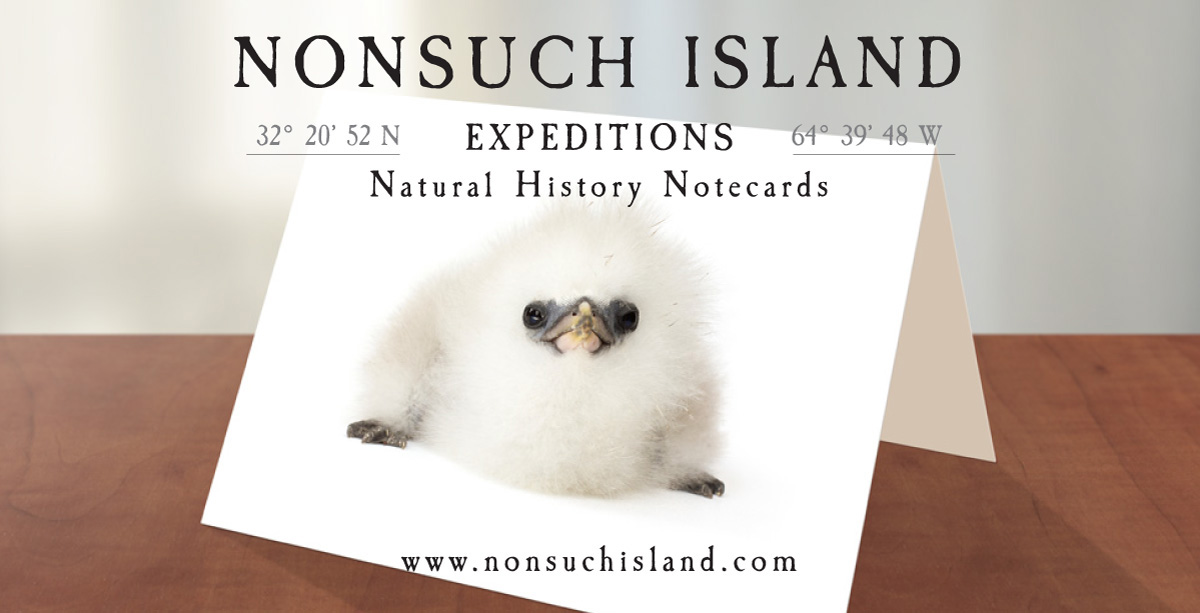
Due to popular demand, a series of Natural History notecards based upon the stunning Nonsuch Expeditions photography has been released.
They may be purchased at the following retailers: The Irish Linen Shop | BUEI | Pulp & Circumstance | The Hamilton Princess & Tuckers Point Resort Shops
They are printed on heavy weight museum quality A6 sized notecards. The image on the front is against a white background, the species and collection details are on the back and the inside of the cards are blank.
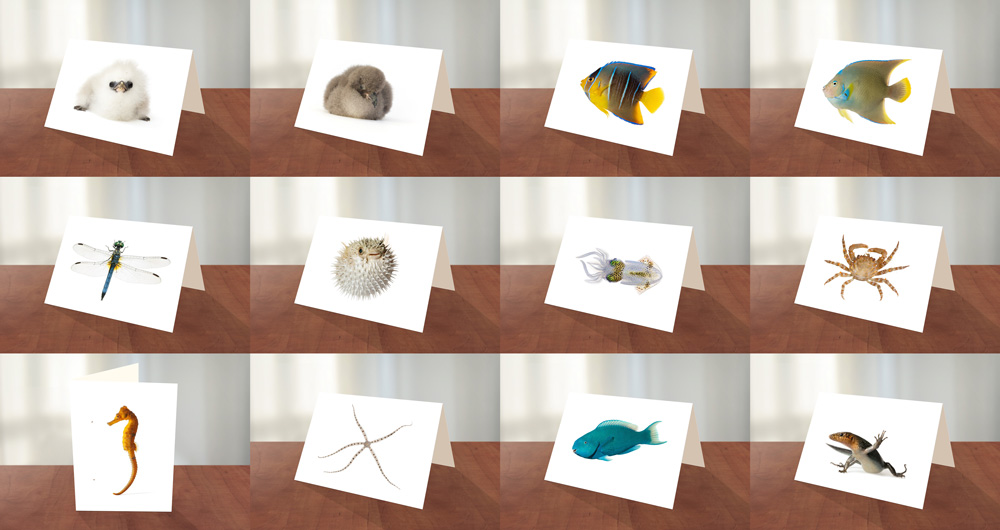
They are also available in the BETA of our online shop here, for delivery or pickup in Hamilton.
Hurricane Nicole Update
Bermuda and Nonsuch Island in particular dodged the proverbial bullet with Hurricane Nicole.
The Category 2 storm passed directly over the island, with Bermuda passing directly through the eye, which resulted in the winds flipping directly from East to West without passing to the South which traditionally causes a tremendous amount of coastal erosion.
The fact that it also passed at low tide further reduced the impact of the southerly swells which in recent storms have been severely impacting the original outlying Cahow nesting islands re-enforcing the importance and urgency of the Nonsuch Translocation Project.
On Nonsuch there was tree damage with large Bay Grapes in particular being uprooted. The salt and wind-burn however was the worst since Hurricane Fabian due in part to the second part of the storm being dry. This has had the side benefit of reducing the number of invasive seedlings and stressing the remaining casuarinas, making the recent round of girdling that much more effective in their removal process.
The timing of this late in the season storm, in mid October, was also quite fortunate, Gonzalo which arrived a week later 2 years prior, drowned 5 pairs of Cahows in their nests which had returned slightly early for their November courtship and nest preparation rituals. This storm being a week earlier does not appear to have had similar effects.
Hurricanes and Nonsuch Island

3am Oct 13th 2016 | Hurricane Nicole is currently approaching Bermuda as a strong Category 3 with a direct hit expected around noon on October 13th. The 130+ mph winds, high seas and storm surge coming in from the south-east for several hours will impact Bermuda's southern coastline including Nonsuch and the other outlying Cahow nesting islands which directly face the open ocean in this direction and are not protected by Bermuda's coral reefs as found on the northern side of Bermuda.
Nonsuch has been evacuated and our team will return to the island as soon as the weather subsides and it is safe to return to asses the damage (not before Friday) and will post updates as soon as we can. This storm is arriving just prior to the start of the 2016/17 nesting season, otherwise we would have run the risk of losing early returning birds as we did in Gonzalo.
Below is a video that we produced that highlights the impact of sea level rise and hurricanes on Nonsuch and why the ongoing translocation process is so important to the survival of the species.